Another locality we visited on our field trip to Arizona was the Arizona-Sonora Desert Museum. True to its name, it has myriad exhibits on the animals, plants, geology, and culture of the Sonoran Desert and associated regions. Unlike what one usually associates with museums, however, the majority of its displays are set outdoors and its animals are living specimens rather than taxidermied mounts. In this respect, it is really more like a zoo crossed with a botanical garden. This also means that the exhibits are set within the very environment that the museum showcases.
Naturally, the zoological components draw the most attention.
Not all of the museum exhibits are outdoors. It does have a small aquarium near the entrance, exhibiting animals from local freshwater ecosystems and the Gulf of California (which the local rivers drain into). Have a moray eel.
Some seahorses.
Nice group of garden eels.
Arizona being the hummingbird hotspot it is (by US standards, rivaled among states only by Texas), it's probably of little surprise that the hummingbird aviary here is one of its major attractions. They have at least seven species exhibited here. Some of them were nesting when we visited, although I didn't get good photos of them doing that. Here is a broad-billed hummingbird to the right, but the one on the left is tougher to call. Broad-tailed?
The Life Underground exhibit takes one... underground, showing how many animals avoid the heat of day by sheltering in burrows, not to mention allowing visitors to experience for themselves the effectiveness of this strategy. As one might expect, these displays were quite dark, so they were not conducive for photography. There were some interesting critters though. This is a kangaroo rat. Though I don't remember which species it represents, desert kangaroo rats are well known for being able to survive without drinking water, being able to subsist entirely on metabolic water.
A spotted skunk.
A ringtail. Wild individuals of these small (but rather predatory) raccoon cousins have been sighted at Chiricahua National Monument on a previous iteration of this field trip.
A glossy snake.
Many of the non-hummingbird avifauna were kept in another walkthrough aviary, though I got the impression that it was more Dove Central than anything. Here is a white-winged dove. I did see (but not satisfactorily photograph) a few other birds in there, however, including a pyrrhuloxia.
Some Inca doves, much smaller than what many of us (accustomed to mourning doves and rock pigeons) expect for doves.
A fossil tortoise shell that apparently had been trodden on by a camel.
A living desert tortoise.
A female bighorn sheep.
A coati. It only ventured into view for a few moments, so this was all I saw of it. Coatis have also been seen in the wild at Chiricahua National Monument on previous versions of this trip, but not this time.
A river otter. Underwater viewing was available for this as well as the beaver display (which I did not get photos of due to crowding around the viewing window).
Being set in the midst of the Sonoran Desert, wild birds are plentiful at the museum. I was trying to see as much of the museum as I could within our allotted time, so I probably did not see as many birds as I would have had I taken a more leisurely pace. (For instance, Dr. Merck and some of my peers saw a wild roadrunner on the trip while I had missed it entirely.) This is a wild cactus wren.
Birds weren't the only wildlife out and about. Here is a rock squirrel. We saw many of these at multiple locations over the course of our field trip.
Coincidentally, it was sitting on top of an exhibit housing fellow ground squirrels, prairie dogs.
A great blue heron. This individual had been rescued after it was injured by a bald eagle attack as a juvenile.
Models of the soil ecosystem at various scales.
A statue depicting some grasshopper mice.
A wild spiny-tailed iguana. They are not native to this region. I am not familiar with the story of how they ended up here, but somehow they haven't spread beyond the museum grounds.
An American kestrel, our smallest falcon.
A model of the forelimb of Sonorasaurus.
Circling back to the entrance, I visited the museum's reptile and amphibian house. It was fairly crowded in there so I only got pictures of a small sample of exhibits. This is a (captive) spiny-tailed iguana.
A San Esteban chuckwalla.
An Arizona black rattlesnake.
A speckled rattlesnake.
Some juvenile chuckwallas.
A vine snake.
Not a bad explanation here.
Some Sonoran green toads (left) and spadefoot (right).
The time for us to rally for the museum's raptor free flight show (more on that below) was approaching, so I headed out towards our rendezvous point. To get there, one had to venture onto what is called the Desert Loop Trail, which is meant to provide a desert hiking experience. There are exhibits situated at various points along the trail as well, including Life on the Rocks, which does quite a good job at simulating the natural settings in which its inhabitants are likely to be found in the wild. There are viewing windows set into crevices in the rocks where arthropods and reptiles live, for instance. It's one of those exhibits that make you work to find the animals, which are always fun. I did not quite have enough time to do much of that here, but I did see this band-tailed pigeon.
There were a large number of what I think are leopard frogs in the stream below.
Continuing onward, I reached Cat Canyon, a quartet of displays containing medium-sized mammals with viewing opportunities from both the sides and from above. Despite its name, not all the animals here were cats. This is a gray fox.
A North American porcupine.
Next up was the raptor free flight show. Viewers stand against three parallel metal railings while raptors are flown above and around them, showcasing some of the birds' natural behaviors. The showrunners rotate several species of raptors for this demonstration, so one never knows exactly what to expect. (On a past iteration of this field trip, they got to see them bring out a roadrunner!) This time, they had a barn owl up first, flying from one perch to the next.
They had a peregrine falcon next, which eschewed perching and did several laps around us in typical falcon style. It flew much too quickly for my camera to catch.
For their grand finale they brought out a group of Harris's hawks, presenting some of their social behaviors and ability to land safely on top of saguaro cacti.
It is difficult to do the flight demonstration justice in words, but suffice it to say that I found it quite spectacular, and the running commentary was informative without being overwhelming for general audiences. For what it's worth, I certainly recommend it.
On our way back out, I passed by a lizard exhibit just outside the main entrance that I hadn't seen when we'd first arrived, so I took the chance to take a quick photo.
Being fit and healthy is important for a long and happy life! Get latest news, videos and photos on health, physical fitness, body fitness, fitness tips, fitness band.
Petrified Forest National Park
Took a ten-day field trip to Arizona in late March. We went all over the place, from the Grand Canyon (in the northern part of the state) to Chiricahua National Monument (in the southeast), but there were a few localities in particular that may be of interest to the readership here.
After camping for two nights in the Grand Canyon, we headed down to Petrified Forest National Park, famous for its Triassic fossils. Not only did we visit the site, we were also given a behind-the-scenes tour of the lab and collections by curator and preparator Matt Smith.
A phytosaur snout in the lab.
It's difficult to tell, but these are remains of Revueltosaurus. Without spilling too much, they have discovered some really interesting things about this animal here. Stay tuned!
Look at this aetosaur skull. Look at it! Amazing specimen.
Being a National Park, Petrified Forest is not only about fossils. Here are specimens of some local wildlife, wood warblers and a spotted skunk, from the collections.
A phytosaur skeletal mount, probably one of the few (if any) depicted in a swimming position. Of note are the bite marks at the end of the snout. Smith emphasized how characteristics like these really drove home the point that fossils are not just lithified bones, not just dusty specimens to slap taxonomic labels on, but the remains of once-living individuals, each with its own life story.
Especially memorable was Smith's description of a fossil weasel skull that he had once prepared. He discussed how, as he worked on the specimen, he gradually uncovered many surprising characteristics that it possessed.
Heavily worn teeth. No cranial sutures at all. Plenty of arthritis.
This weasel may have been small enough to hold in one hand, but it evidently lived to a ripe old age.
Not just a specimen. An individual.
I confess, as fascinating as I found the tour, I had had some concerns that it would not resonate as well with my peers. Smith had used a number of technical terms in parts of the tour that were likely unfamiliar to most of them and potentially daunting. (Not all of us on the trip were geology students, let alone paleo-savvy.) Overhearing several conversations afterward, however, I discovered that my reservations were naive and moot. Not only had many of my fellow students learned a lot about paleontological work, some of them considered the tour to be the highlight of our field trip up to this point. I was glad.
After the tour, we continued on towards the southern end of the park. Along the way, we stopped to have a look at the Chinle Formation and its paleosols.
We had hoped to visit the Rainbow Forest Museum at the other end of the park, but, alas, it was closed by the time we got there. We were still able to take a short walk just outside it, giving us good looks of the petrified trees that gave the park its name (and its National Park status).
A cholla cactus. Had we gone to Saguaro National Park during our trip (as had been planned, but ended up being cancelled at the last minute), we would have seen a lot more of these. As things stood though, we were able to observe this one at a safe distance.
After camping for two nights in the Grand Canyon, we headed down to Petrified Forest National Park, famous for its Triassic fossils. Not only did we visit the site, we were also given a behind-the-scenes tour of the lab and collections by curator and preparator Matt Smith.
A phytosaur snout in the lab.
It's difficult to tell, but these are remains of Revueltosaurus. Without spilling too much, they have discovered some really interesting things about this animal here. Stay tuned!
Look at this aetosaur skull. Look at it! Amazing specimen.
Being a National Park, Petrified Forest is not only about fossils. Here are specimens of some local wildlife, wood warblers and a spotted skunk, from the collections.
A phytosaur skeletal mount, probably one of the few (if any) depicted in a swimming position. Of note are the bite marks at the end of the snout. Smith emphasized how characteristics like these really drove home the point that fossils are not just lithified bones, not just dusty specimens to slap taxonomic labels on, but the remains of once-living individuals, each with its own life story.
Especially memorable was Smith's description of a fossil weasel skull that he had once prepared. He discussed how, as he worked on the specimen, he gradually uncovered many surprising characteristics that it possessed.
Heavily worn teeth. No cranial sutures at all. Plenty of arthritis.
This weasel may have been small enough to hold in one hand, but it evidently lived to a ripe old age.
Not just a specimen. An individual.
I confess, as fascinating as I found the tour, I had had some concerns that it would not resonate as well with my peers. Smith had used a number of technical terms in parts of the tour that were likely unfamiliar to most of them and potentially daunting. (Not all of us on the trip were geology students, let alone paleo-savvy.) Overhearing several conversations afterward, however, I discovered that my reservations were naive and moot. Not only had many of my fellow students learned a lot about paleontological work, some of them considered the tour to be the highlight of our field trip up to this point. I was glad.
After the tour, we continued on towards the southern end of the park. Along the way, we stopped to have a look at the Chinle Formation and its paleosols.
We had hoped to visit the Rainbow Forest Museum at the other end of the park, but, alas, it was closed by the time we got there. We were still able to take a short walk just outside it, giving us good looks of the petrified trees that gave the park its name (and its National Park status).
A cholla cactus. Had we gone to Saguaro National Park during our trip (as had been planned, but ended up being cancelled at the last minute), we would have seen a lot more of these. As things stood though, we were able to observe this one at a safe distance.
Skimming with Semirostra
It's been a year since the clade Volantia was established, uniting all flying organisms as a monophyletic group. Hot off the presses today, the next stage in advancing research of this newly recognized clade has been unveiled.
Traditionally, birds, bats, pterosaurs, insects, and planes have been considered the only groups capable of powered flight, and it was these groups that were analyzed in the original. However, it is being increasingly recognized that other groups, such as rockets, hot air balloons, and squid should all be considered part of this roster. The new study includes these taxa and more in the most comprehensive phylogenetic analysis of the clade yet. (Sample size of two? What does that mean?)
The results confirm that the jet/heat-propelled groups are highly specialized volantians and, in fact, are each others' closest relatives. In addition, taxa such as dragons, griffons, and pegasi, long thought to be entirely mythical, were also included on the basis of oft-maligned but truly overwhelming evidence such as anecdotal accounts on Ask.com.
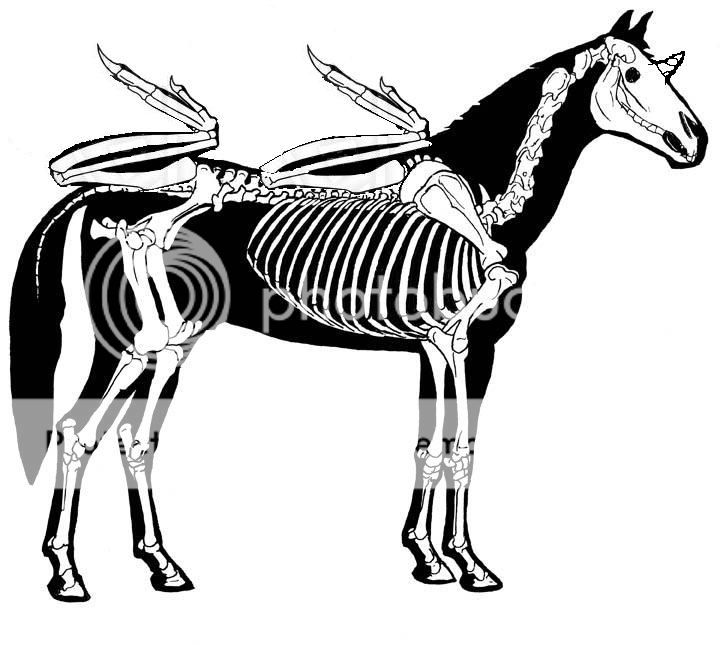
One of the most common criticisms leveled at the original paper coining Volantia was its choice of unicorns as the outgroup in its phylogenetic analysis, with good reason. There is a wealth of evidence supporting a flying ancestry for unicorns, including widely publicized developmental data showing that wing-making genes can be activated even in their postnatal development. What's more, fossil evidence now exists to further corroborate these conclusions, for last year also saw the announcement of the pegacorn (rumored name "Pegasoceras wimmeri"), known from a well-preserved fossil representing what appears to be a four-winged stem member of the clade including both unicorns and pegasi. It was widely dubbed in the press the Pony from Hell, because ponies don't receive enough attention and a four-winged pseudo-horse is not spectacular enough of a find to attract the media on its own merits. The new analysis takes the opportunity to amend the oversight of the original, deeming unicorns secondarily flightless volantians.
Most intriguing of all, however, may be the discovery of another clade of secondarily flightless volantians, hitherto unrecognized. Not only secondarily flightless, in fact, but also secondarily aquatic. This is the clade Halirostra, which includes Semirostrum ceruttii (initially thought to have been a porpoise) and the Hemiramphidae or halfbeaks (long thought to be actinopterygians). Some species of halfbeaks are still able to glide over the surface of the water, further testament to their flying ancestry.
What were the flighted ancestors of halirostrans like? An extant taxon may provide some clues. The Rynchopidae or skimmers have long been thought to be birds, but the new analysis demonstrates conclusively that this is not the case. In reality, they sharejust one several important features with the halirostrans, such as a prognathous mandible. Besides, their slit pupils should have been a dead giveaway that skimmers are not really birds.
Together with pterosaurs, skimmers and halirostrans are found to form the clade Semirostra. This has interesting implications for the paleobiology of the extinct members of this group. Skimmers are famous for their distinctive skim-feeding method of foraging. As they are the only extant proxies of extinct semirostrans*, perhaps it's time to take another look at the all too hastily discredited notion that pterosaurs also skim fed. Using the method Use Photoshop and Look Really Hard (UPALRH), pioneered by Dave Preter, and a healthy dose of SRC, the researcher behind today's study was able to see previously unknown features in pterosaur fossils, including eyeballs, elongated mandibles, speech bubbles, and the original surface of the water in which the pterosaurs had been skimming in prior to their death, providing support for the much cooler idea that pterosaurs could skim feed, no matter what those dang clueless biomechanists say.
*Halfbeaks don't count, they are faaaaaaaar too different.
And Semirostrum? Why not?
We may be momentarily astonished by these revelations, but in hindsight they are incredibly conspicuous. It is a wonder that professional scientists have not yet put together the true relationship between pterosaurs and skimmers when it could easily be proven by taking quotes from abstracts of scientific articles and Wikipedia out of context. Once again, this demonstrates that the scientific community are an incompetent lot who have to be given reality checks by untrained amateurs that hold the true keys to the ultimate truth, because of Galileo and some crap. (Who was Galileo anyway?)
Special thanks to Thomas Holtz and Logan Orlowski for assisting me in the coverage of this revolutionary new paper.
References
Claw, A. and I.M.A. Troll. 2011. A new and extremelyinaccurate method for inferring the integument of extinct maniraptors. Journal That Sometimes Accepts Silly Things 1: 1-9. doi: WTF/???sdflkjsdf
Humphries, S., R.H.C. Bonser, M.P. Witton, and D.M. Martill. 2007. Did pterosaurs feed by skimming? Physical modelling and anatomical evaluation of an unusual feeding method. PLoS Biology 5(8): e204. doi: 10.1371/journal.pbio.0050204
Larson, M.A. 2013. Magical mystery cure. The Hub 4: 13. doi: 413/mlp.fim.90123
Muramatsu, K., J. Yamamoto, T. Abe, K. Sekiguchi, N. Hoshi, and Y. Sakurai. 2013. Oceanic squid do fly. Marine Biology 160: 1171-1175. doi: 10.1007/s00227-013-2169-9
Orlowski, L. 2013. Fossil evidence for a secondarily flightless ancestry in unicorns. The Proboscipoda Annual Conference Abstracts 1A: 7-12. doi: 42.1007/666.x4351
Preter, D. 2000. Look at all this kool stuff. Empire of King Preter 1: 1-9. doi: 9999.dsf91.999
Racicot, R., T. Deméré, B. Beatty, and R. Boessenecker. 2014. Unique feeding morphology in a new prognathus extinct porpoise from the Pliocene of California. Current Biology 24: 774–779. doi: 10.1016/j.cub.2014.02.031
Troll, I.M.A. 2013. A four-winged configuration for basal birds: implications for the Single Origin of Flight (SOF) Hypothesis. Journal of Random Crap 1: 1-5. doi: 42.1007/s42336.012.0910.7
Troll, I.M.A. 2014. Skimming, fire-breathing, and secondary flightlessness: a comprehensive phylogenetic analysis of the newly recognized clade Volantia shows hitherto unknown diversity. Journal of Random Crap 2: 1-5. doi: 42.1007/s42336.013.0910.7
Traditionally, birds, bats, pterosaurs, insects, and planes have been considered the only groups capable of powered flight, and it was these groups that were analyzed in the original. However, it is being increasingly recognized that other groups, such as rockets, hot air balloons, and squid should all be considered part of this roster. The new study includes these taxa and more in the most comprehensive phylogenetic analysis of the clade yet. (Sample size of two? What does that mean?)
The results confirm that the jet/heat-propelled groups are highly specialized volantians and, in fact, are each others' closest relatives. In addition, taxa such as dragons, griffons, and pegasi, long thought to be entirely mythical, were also included on the basis of oft-maligned but truly overwhelming evidence such as anecdotal accounts on Ask.com.
One of the most common criticisms leveled at the original paper coining Volantia was its choice of unicorns as the outgroup in its phylogenetic analysis, with good reason. There is a wealth of evidence supporting a flying ancestry for unicorns, including widely publicized developmental data showing that wing-making genes can be activated even in their postnatal development. What's more, fossil evidence now exists to further corroborate these conclusions, for last year also saw the announcement of the pegacorn (rumored name "Pegasoceras wimmeri"), known from a well-preserved fossil representing what appears to be a four-winged stem member of the clade including both unicorns and pegasi. It was widely dubbed in the press the Pony from Hell, because ponies don't receive enough attention and a four-winged pseudo-horse is not spectacular enough of a find to attract the media on its own merits. The new analysis takes the opportunity to amend the oversight of the original, deeming unicorns secondarily flightless volantians.
Most intriguing of all, however, may be the discovery of another clade of secondarily flightless volantians, hitherto unrecognized. Not only secondarily flightless, in fact, but also secondarily aquatic. This is the clade Halirostra, which includes Semirostrum ceruttii (initially thought to have been a porpoise) and the Hemiramphidae or halfbeaks (long thought to be actinopterygians). Some species of halfbeaks are still able to glide over the surface of the water, further testament to their flying ancestry.
![]() |
| Phylogeny of Volantia, from Troll, 2014. The blue dot marks the newly-coined clade Halirostra and the red marks Semirostra. |
What were the flighted ancestors of halirostrans like? An extant taxon may provide some clues. The Rynchopidae or skimmers have long been thought to be birds, but the new analysis demonstrates conclusively that this is not the case. In reality, they share
Together with pterosaurs, skimmers and halirostrans are found to form the clade Semirostra. This has interesting implications for the paleobiology of the extinct members of this group. Skimmers are famous for their distinctive skim-feeding method of foraging. As they are the only extant proxies of extinct semirostrans*, perhaps it's time to take another look at the all too hastily discredited notion that pterosaurs also skim fed. Using the method Use Photoshop and Look Really Hard (UPALRH), pioneered by Dave Preter, and a healthy dose of SRC, the researcher behind today's study was able to see previously unknown features in pterosaur fossils, including eyeballs, elongated mandibles, speech bubbles, and the original surface of the water in which the pterosaurs had been skimming in prior to their death, providing support for the much cooler idea that pterosaurs could skim feed, no matter what those dang clueless biomechanists say.
*Halfbeaks don't count, they are faaaaaaaar too different.
![]() |
| Reinterpretation of a specimen of the pterosaur Darwinopterus modularis after applying UPALRH and SRC, from Troll, 2014 and modified from a photograph by Didier Descouens, licensed. |
And Semirostrum? Why not?
![]() |
| Restoration of Semirostrum ceruttii depicting it utilizing the foraging method suggested in Troll, 2014. |
We may be momentarily astonished by these revelations, but in hindsight they are incredibly conspicuous. It is a wonder that professional scientists have not yet put together the true relationship between pterosaurs and skimmers when it could easily be proven by taking quotes from abstracts of scientific articles and Wikipedia out of context. Once again, this demonstrates that the scientific community are an incompetent lot who have to be given reality checks by untrained amateurs that hold the true keys to the ultimate truth, because of Galileo and some crap. (Who was Galileo anyway?)
Special thanks to Thomas Holtz and Logan Orlowski for assisting me in the coverage of this revolutionary new paper.
References
Claw, A. and I.M.A. Troll. 2011. A new and extremely
Humphries, S., R.H.C. Bonser, M.P. Witton, and D.M. Martill. 2007. Did pterosaurs feed by skimming? Physical modelling and anatomical evaluation of an unusual feeding method. PLoS Biology 5(8): e204. doi: 10.1371/journal.pbio.0050204
Larson, M.A. 2013. Magical mystery cure. The Hub 4: 13. doi: 413/mlp.fim.90123
Muramatsu, K., J. Yamamoto, T. Abe, K. Sekiguchi, N. Hoshi, and Y. Sakurai. 2013. Oceanic squid do fly. Marine Biology 160: 1171-1175. doi: 10.1007/s00227-013-2169-9
Orlowski, L. 2013. Fossil evidence for a secondarily flightless ancestry in unicorns. The Proboscipoda Annual Conference Abstracts 1A: 7-12. doi: 42.1007/666.x4351
Preter, D. 2000. Look at all this kool stuff. Empire of King Preter 1: 1-9. doi: 9999.dsf91.999
Racicot, R., T. Deméré, B. Beatty, and R. Boessenecker. 2014. Unique feeding morphology in a new prognathus extinct porpoise from the Pliocene of California. Current Biology 24: 774–779. doi: 10.1016/j.cub.2014.02.031
Troll, I.M.A. 2013. A four-winged configuration for basal birds: implications for the Single Origin of Flight (SOF) Hypothesis. Journal of Random Crap 1: 1-5. doi: 42.1007/s42336.012.0910.7
Troll, I.M.A. 2014. Skimming, fire-breathing, and secondary flightlessness: a comprehensive phylogenetic analysis of the newly recognized clade Volantia shows hitherto unknown diversity. Journal of Random Crap 2: 1-5. doi: 42.1007/s42336.013.0910.7
Veterans get free relief through alternative medicine (Video)
"Nearly 100 veterans have found relief through Healing Warriors Program, a Northern Colorado nonprofit that provides free and reduced-cost alternative medicine treatments."
For David Sykes, 63, that relief is at the prick of a needle. He travels from Greeley to Fort Collins every other week for acupuncture with Healing Warriors acupuncturist Abbye Silverstein.
The U.S. Marine Corps Vietnam veteran has worked with the program since August and found it to be “very beneficial” in dealing with post-traumatic stress disorder, a sciatic nerve injury caused by jumping repeatedly out of choppers and social issues caused by his frustration and pain.
I was in during the Vietnam era and it would have been nice to have this forward looking treatment available then. As the saying goes, better late then never.
'via Blog this'
http://www.coloradoan.com/article/20140320/LIFESTYLE09/303200077/Veterans-get-free-relief-through-alternative-medicine
For David Sykes, 63, that relief is at the prick of a needle. He travels from Greeley to Fort Collins every other week for acupuncture with Healing Warriors acupuncturist Abbye Silverstein.
The U.S. Marine Corps Vietnam veteran has worked with the program since August and found it to be “very beneficial” in dealing with post-traumatic stress disorder, a sciatic nerve injury caused by jumping repeatedly out of choppers and social issues caused by his frustration and pain.
I was in during the Vietnam era and it would have been nice to have this forward looking treatment available then. As the saying goes, better late then never.
'via Blog this'
http://www.coloradoan.com/article/20140320/LIFESTYLE09/303200077/Veterans-get-free-relief-through-alternative-medicine
Isle of Wight: MP raises cost effectiveness of complementary medicine
"THE issue of alternative therapies being considered by officials on the Island has been raised in the House of Commons by MP Andrew Turner."
'via Blog this'
Isle of Wight: MP raises cost effectiveness of complementary medicine:
'via Blog this'
Isle of Wight: MP raises cost effectiveness of complementary medicine:
American Museum of Natural History Round Two
Sometimes I can get trip reports up in a reasonable amount of time. Who knew?
Once again the opportunity to visit the AMNH had exposed itself, so of course I was coming along.
The trip proceeded similarly to last time, with Drs. Holtz and Merck giving quick tours on their areas of expertise. It was a bit disconcerting to hear a fellow student identify an ichthyosaur variously as a "fish" and a "dinosaur" even after having heard enough of Dr. Merck's talk to have known better. On the bright side, seeing others genuinely surprised by Dimetrodon being a stem mammal rather than a reptile showed that quality science education is not for naught.
What was different was that this time I didn't get an exclusive tour - not a loss, because I hadn't expected one - and I didn't have to do an assignment, which meant I had much more time to look at and photograph the exhibits. That said, I don't have many pictures to share as I'd hoped. Of relevance is that the glass cases many AMNH specimens are exhibited in are not always conducive to photography, though I think I may have also been having too much fun listening and talking to Drs. Holtz and Merck and Eugenia.
The synapsid halls included some really nice paintings by Jay Matternes that I hadn't seen last time. This is a restoration by him of Paramys.
As a centerpiece, many mounts of hoofed mammals (some closely related, others not) were set alongside each other for comparison. This is good old Toxodon, a member of a clade of South American hoofed mammals whose relationships are still enigmatic.
Up above, a narwhal. Yep, whales are artiodactyls, and thus descended from hoofed animals.
Gomphotherium (a proboscidean afrothere) with a horse (a perissodactyl) and the aforementioned Toxodon in the background.
Remains of pikas (and a hamster) preserved together, probably accumulated by a predator. You can see the fossils better from the front...
The skull of Macrauchenia, another one of those enigmatic extinct South American mammals.
Paleoparadoxia, a desmostylian afrothere.
Metaxytherium, a fossil dugong.
The skull of Moeritherium, a stem elephant.
Suddenly, a Mesozoic reptile. This is Placodus, a placodont. Some have suggested that it led a lifestyle similar to sirenians. I can certainly see some superficial skeletal similarities.
The geology exhibits at the AMNH were really good. This is a demonstration of orogenesis (mountain building) using colored sand.
This display is about the deformation of rocks (as suggested by the sign). On the left is undeformed rock, while those to the right have been exposed to successively higher pressures.
On our way to the human origins hall (which I'd neglected to take pictures of), we passed by a trilobite display sitting out almost in the middle of nowhere. I photographed a few that I thought looked interesting. Here are (from left to right) Walliserops, Dicranurus monstrosus, and Dicranurus hamatus.
This one is Asaphus.
No dinosaur pictures at all? What sorcery is this?
Once again the opportunity to visit the AMNH had exposed itself, so of course I was coming along.
The trip proceeded similarly to last time, with Drs. Holtz and Merck giving quick tours on their areas of expertise. It was a bit disconcerting to hear a fellow student identify an ichthyosaur variously as a "fish" and a "dinosaur" even after having heard enough of Dr. Merck's talk to have known better. On the bright side, seeing others genuinely surprised by Dimetrodon being a stem mammal rather than a reptile showed that quality science education is not for naught.
What was different was that this time I didn't get an exclusive tour - not a loss, because I hadn't expected one - and I didn't have to do an assignment, which meant I had much more time to look at and photograph the exhibits. That said, I don't have many pictures to share as I'd hoped. Of relevance is that the glass cases many AMNH specimens are exhibited in are not always conducive to photography, though I think I may have also been having too much fun listening and talking to Drs. Holtz and Merck and Eugenia.
The synapsid halls included some really nice paintings by Jay Matternes that I hadn't seen last time. This is a restoration by him of Paramys.
As a centerpiece, many mounts of hoofed mammals (some closely related, others not) were set alongside each other for comparison. This is good old Toxodon, a member of a clade of South American hoofed mammals whose relationships are still enigmatic.
Up above, a narwhal. Yep, whales are artiodactyls, and thus descended from hoofed animals.
Gomphotherium (a proboscidean afrothere) with a horse (a perissodactyl) and the aforementioned Toxodon in the background.
Remains of pikas (and a hamster) preserved together, probably accumulated by a predator. You can see the fossils better from the front...
The skull of Macrauchenia, another one of those enigmatic extinct South American mammals.
Paleoparadoxia, a desmostylian afrothere.
Metaxytherium, a fossil dugong.
The skull of Moeritherium, a stem elephant.
Suddenly, a Mesozoic reptile. This is Placodus, a placodont. Some have suggested that it led a lifestyle similar to sirenians. I can certainly see some superficial skeletal similarities.
The geology exhibits at the AMNH were really good. This is a demonstration of orogenesis (mountain building) using colored sand.
This display is about the deformation of rocks (as suggested by the sign). On the left is undeformed rock, while those to the right have been exposed to successively higher pressures.
On our way to the human origins hall (which I'd neglected to take pictures of), we passed by a trilobite display sitting out almost in the middle of nowhere. I photographed a few that I thought looked interesting. Here are (from left to right) Walliserops, Dicranurus monstrosus, and Dicranurus hamatus.
This one is Asaphus.
No dinosaur pictures at all? What sorcery is this?
Apple gets Corporate Cultural Health Award
It Is one thing for heads of state or private citizen to pay tribute to the great African chief and President in Mandela. It is another thing for a company to do so by putting Mandela Front and center on their website.
In a time when many companies stand for nothing in the era of Bankster's, greed is good and mediocre products, apples Moral tone and tenure stand out.
For this I judge that they get the corporate cultural health award for 2013.
Both Jobs and Mandela we're great visionaries that left the world a better place than when they found it.
Subscribe to:
Posts (Atom)