Ueno Zoo Part I: East Garden Entrance

Japanese zoos generally don't have great reputations when it comes to quality animal care, especially compared to many of the world-class zoos we have in North America, but Ueno Zoo has modernized decently. A number of enclosures for larger animals felt a tad small and sometimes drab, but most of the small animals (which I tend to be more interested in) looked like they had adequate homes.

The zoo is sharply divided into East and West Gardens (connected by a long bridge), the main entrance leading into the East Garden. Among the first exhibits one can visit upon entering is a series of aviaries containing native Japanese birds. I tend to like exhibits that showcase native fauna (and have been to one zoo/museum that does almost nothing but). The inhabitants are not always the most charismatic of species, but I find that the general public doesn't always have the best understanding of the species it share its own neighborhoods with. On top of that, many species exhibited in these displays can be highly unfamiliar to foreigners (like me) and thus make for interesting sights by that simple virtue alone. This bird here is a Lidith's jay and, as it happens, it's not a species I would expect even a Tokyo native to know, as it's found in the wild only on two of the Ryukyu Islands.

A white-breasted waterhen. I've seen these in the wild before, but in typical rail fashion you're more likely to hear them first (in spite of their bold color patterning compared to most other rails).

A rock ptarmigan.

An azure-winged magpie. I'd hoped to see these in the wild on my trip because my field guide to Japanese birds claimed that they were "common" in Tokyo, but I didn't have much luck there. The field guide was published in 1982, so it is understandably dated in some respects. For instance, a pamphlet I received at the Tokyo Port Wild Bird Park had many discrepancies from the field guide in terms of bird distribution and abundance. (The azure-winged magpie is said to be "fairly common", for what it's worth.) Yet, from a cursory Google search, it appears that my book is still among the best when it comes to English field guides to Japanese birds.

A Eurasian jay.

Its cage was also accessible by fellow acorn lovers, Japanese squirrels.

The wire tunnel leading to the main squirrel enclosure.

A few of the other aviaries exhibit smaller passerines, but most of those birds proved too active to be easily photographed.

There was a little island with waterfowl inhabitants (and big flocks of wild Eurasian tree sparrows that would take their share of food). From left to right: Canada goose, swan (I do not remember the exact species), and emperor goose (partially hidden behind foliage).

Some prairie dogs. They have a tunnel system cross-sectioned by a viewing window so guests can see inside, but they were content to stay above ground on my visit.

An example of the zoo's more subpar enclosures with this cramped- and drab-looking exhibit for colobus monkeys. Sad to say, this was part of a row of monkey displays that didn't look much better than this.

Off in another corner near the zoo entrance is another series of aviaries, this time centered around gamebirds and pigeons. This is a bare-faced curassow.

A pied imperial pigeon, rather conspicuously colored for a forest bird.

A Palawan peacock pheasant. Neat.

Green pheasants (considered a subspecies of ring-necked pheasant by the zoo signage and my field guide), a Japanese endemic.

Australian brush turkeys, which are really megapodes and not turkeys.

Oh right, there is a giant panda exhibit in this part of the zoo as well. In general, I've never been much taken with charismatic megafauna to begin with, but giant pandas are even less of a draw when I can visit what is considered to be one of the best giant panda displays in the world for free a good chunk of the year. Giant pandas are interesting animals to be sure, but I find that they very much have a "seen them once, seen them all" quality. While crowdpleasing creatures may be important for overall zoo attendance, I've always been of the opinion that if you want to see some true rarities (in terms of ubiquity in zoos rather than in the wild, though both can apply), you go look at the smaller animals in the collection. That's not to say there aren't plenty of large animals that could use more representation in zoos, but space that could be spent on them are often used for more commonplace (again by zoo standards, not wilderness standards) crowdpleasers, whereas smaller clients are easier to accommodate with limited room. So skip the pandas I did.

National Museum of Nature and Science, Tokyo

The National Museum of Nature and Science in Tokyo is big. Not as big as the AMNH, but big enough to spend the better part of a day inside. And as I'd intended to visit the Ueno Zoo later on the same day, I did not have time to spend all the better part of my day at the museum, so it certainly seemed big to me. (The only other day left on my trip had been a Monday, on which both the zoo and museum are closed, so I couldn't afford to assign my intended destinations to different days.) As a result, I had to cut my museum trip shorter than I otherwise would have liked. Nonetheless, I spent enough time there to look at their paleontology halls and they were well worth it.

Dinosaurs have a dedicated hall to themselves on a different floor from the other fossil displays. The first exhibit compares the skeleton of a human with that of Bambiraptor. The sign to the left labels the homologous elements shared between them.

One thing especially nice to see at the museum: cladograms! They were rather common on the signage, including these big panels featuring various theropod taxa, from one of the earliest...

... to one of the most recent.

Bambiraptor also serves as the example used in the "how fossils are discovered and studied" display. The life restoration... could be better, but it's not the worst that I'm aware of.

In general, life restorations were not the strongest part of the hall, but there were mercifully few of them. The vast majority of focus was on fossils. Most of the other life restorations came in the form of animated models on display screens, like the one you can see to the left here. Many contained clips of paleontologists explaining information related to the displays. It was entertaining to see familiar faces accompanied by Japanese dubbing. More to the point though, this sign was of particular interest to me as it pertained to that maniraptoran trademark, the semilunate carpal!

Here are the skeletons to match (from left to right): an unnamed dromaeosaurid, Archaeopteryx, and a Ural owl (with taxidermy counterpart). Herrerasaurus is also partially visible to the left.

A nice hadrosaur collection was present. The skull to the right is an animatronic model showing the chewing motions of hadrosaurs.

The obligatory parasagittal stance display.

A rauisuchian-type pseudosuchian hanging out with the dinosaurs.

The skull of Carcharodontosaurus.

Up above (as it was attached to a mount), the skull of Tyrannosaurus.

In front of the Tyrannosaurus was an arctometatarsal display. You get two guesses to which paleontologist was on the adjacent display screen and the first guess doesn't count.

The ceratopsian skull gallery (from left to right): Styracosaurus, Pachyrhinosaurus, Anchiceratops, and Chasmosaurus.

A Pachycephalosaurus duo.

Stegosaurus with the tail of Euoplocephalus in the foreground. It struck me that the hand positions of many of the mounts all looked rather up to date.

The main fossil hall is (understandably) much bigger than the dinosaur hall. Most vertebrate groups (synapsids in particular) were well represented (aside from non-amniote tetrapods and terrestrial non-dinosaurian reptiles), while the invertebrate collection was also goodly sized. There was a nice display comparing secondarily aquatic amniote groups (with a mount of Llanocetus, a new sight for me) and a large section on human evolution. In spite of its size and breadth, it turns out that, through a combination of conscious (saving my camera battery so I could continue using it at the zoo) and unconscious (being awestruck by the displays) influence, I only took one (blurry) picture: the skull of Paraceratherium.

Continuing with the trend of rarely-seen stuffed animals in Japan, some plush Anomalocaris from the gift shop!

Sumida Aquarium

Went on a trip to Tokyo this past week and, my goodness, do I have many photos to share. The public transportation system in Tokyo is incredible, by the way. They can get you from anywhere to anywhere else in less than an hour most of the time (and usually much quicker than that). In fact, many of the attractions I visited lacked adequate parking facilities and encouraged visitors to reach them by public transport instead. It can, however, get extremely crowded during peak times. Among the many locations I stopped by that may be of interest, first was the Sumida Aquarium.

The aquarium is situated on Tokyo Skytree, the tallest human-constructed structure in Japan. Here is a shot of the first displays you see upon entering. They are mainly intended to showcase big-picture concepts such as freshwater ecosystems and natural aquascaping, so the animal species exhibited are mostly commonplace ones you can often find in pet stores (e.g.: many tetra, rainbowfish, and catfish species).

There is a nice jellyfish collection at the aquarium. I'd even consider their jellyfish collection one of their highlights, for there were many species I had not seen in North American aquariums. That said, moon jellies are rather pedestrian.

Ctenophores, however, are less commonly represented. These are Bolinopsis mikado. Okay, they are not jellyfish, but they're also known as comb jellies and were exhibited alongside true jellyfish.

Here are some rarely-seen jellyfish that really are jellyfish, flower hat jellies.

Another one, a clinging jellyfish. Upon cursory research, it appears that all these species can be found in the waters near Japan, which is also true for the vast majority of other animals at this aquarium.

Next we come to a series of small tanks set into the wall, each showcasing a different species. These are red-toothed triggerfish.

A few other tanks nearby had deep-sea organisms in them, which was interesting to see. Here are a basket star and an isopod.

A species of weever. Confusingly, trachinid fish are also called weevers, so sandperch may be the less disorienting name for this fish and its close kin.

A Japanese catfish.

The centerpiece of the aquarium is a large exhibit for what I think are Magellanic penguins. It may well have been the largest penguin exhibit I've ever seen and almost certainly the one that holds the greatest number of penguins. These photos do not quite do it justice. The exhibit itself is situated on the lower floor of the aquarium (whereas the first displays you encounter are on the top floor), but it is also visible from above.

The remaining displays on the top floor are a number of decently-sized tanks recreating coral reef habitats. One of these is almost exclusively home to garden eels. ("Almost exclusively" because shrimpfish were also present.) Despite the fact that these eels live in groups, I saw quite a few individuals squabbling amongst themselves. A rarer sight was one of them leaving its burrow and swimming around in the water column for quite some time! (Sadly, I don't have photos of that.)


A Japanese bullhead shark.

On the way to the lower floor, one goes down a sloping hallway with displays of various Japanese sea life along the way. These are conger eels.

Some crabs that weren't identified more specifically than "sesarmids".

Once on the lower floor proper, there is a large tank (also partially visible from the upper floor) that displays the marine ecosystem surrounding the islands offshore of Tokyo. I have... no pictures of it. I need to consider getting better representative photographs of institutions on my next trip someplace.

A view of the penguins from the lower floor, though crowds and constant movement made photography difficult.

Had you shown these fish to me without naming them, I would have readily identified them as mudskippers. In fact, they are leaping blennies, but they are so mudskipper-like to my eye that I wondered whether that was an alternative name for mudskipper for the longest time!

Somewhat hidden behind the large penguin exhibit is a similarly designed, but much smaller, enclosure for fur seals. (I did not catch the exact species.)

I came away from my travels with the impression that Japan has a strong general interest in natural history. This is evident from the obscure biological origins of many Pokémon, but some of the most striking examples came from the merchandise they sell in their gift shops! I don't remember ever seeing so many products based on garden eels in one place, not even in North American aquariums that exhibit them. Most eyecatching of all were these giant plush renditions that looked like bizarre candy canes.

This is but a minute selection of the much smaller plush accessories they had, including isopods, squid, Dumbo octopuses, oarfish, and anglerfish (of two species)!

They even had a variety of marine-biology-themed confectioneries.

Tumblr Roundup 5/29/14

Been a while since the last one!

-Does the comic Claming the Throne have permission to mention Raptormaniacs?
-Why would anyone not like Skull?
-Why does Skull keep going on about his plans if he knows he won't succeed?
-How does Skull know his plans won't ever succeed?
-Has Skull ever thought of assembling an army of insects to take over the museum?
-Where are the characters' coverts, primaries, and secondaries?
-If the characters had the chance to make a summer blockbuster, what would it be?
-Have the characters met any hesperornithines?
-Where have the characters been?
-Do the characters interact with the modern animals at the museum?
-Have the characters met any sauropods?
-Are there any mammaliaforms at the museum?
-If Savape causes so much damage, how does she avoid getting kicked out?
-Can the characters fly?
-Is Skull the only dinosaurian skull cast?
-Have the characters ever fallen sick?
-Does Remex like cheese?
-Is Zahavi familiar with the work of his namesake scientist?
-Have the characters dealt with young-Earth creationists?
-What would a visit to the Acme Museum be like for us?
-Will the museum ever give Skull a body?
-A plea for the characters to come back.
-Is there a Drinker in the museum?
-Does anyone try to sneak drugs and alcohol into the museum?
-The characters respond to chirping noises.
-Has Savape ever used a Swiss army knife?
-The characters respond to being called cute.
-Does Savape try to steal people's stuff?

Apple Announces Health Kit - Droids go blind!

The world is expecting Apple on June 2 to announce Health Book (Kit) and rewrite the book on personal bio-metrics even before the Iwatch is announced. The Droid people are worried about Health Kit and the deteriorating health of Droids. Read this important Droid story that the Apple announcements are overshadowing.


Not only is the Apple announcement at their Developers conference about to Blind side the Droid tribe again. But evidence has surfaced that Droid was blind before the conference. Droids don't have a sophisticated motion chip like Iphones M7 chip but we assumed they could tell where they were in space. Well it turns out they can't. (:-( 


I have often reported about the importance of getting the most for your money. In portable computing Technology the gold standard is Iphone period. This article demonstrates yet another example of Iphone clone (Droid) mediocrity.

A wise man once said, "you may not always get what you pay for but you never get what you don't pay for".

A new article "Bounden delays iOS to Android port - Google phones' gyroscopes don't work" lays out the details of why cheap is not better and can actually be very bad.


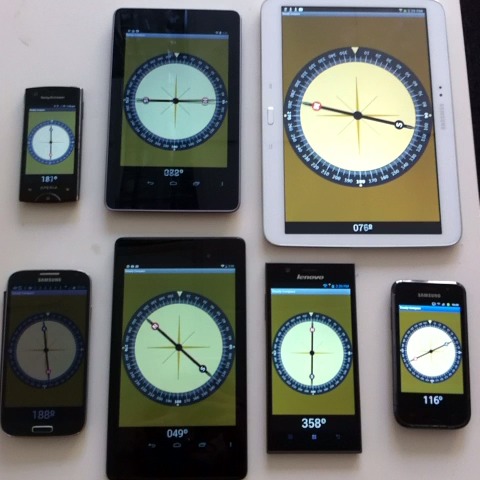
See video below: The Droid "Giro" accuracy is all over the place. In some cases there is no Gyroscope. They really dupe the technologically illiterate by simulating a Gyro using a compass and accelerometer, WOW. The Droids literally do not know where they are


This is a good example why most A class developers create apps for the Iphone first. You write the app once for the gold standard and it runs on all IOS devices. Just for the Droids in this picture the App developer (in this case Bounden) would have to write 6 different apps to run on Droid. The fact is to cover all the Iphone clones (droids) the developer would have to maybe make"100" different Apps. No developers are going to do that.

One of the interesting numbers from WWDC 2014 is that 89% of apples users have the latest operating system (the software the apps live in). but only 9% of Droid users have the latest Operating system. What does this mean to us as users? Think about it if you were a developer (makes apps) would you spend your valuable time writing you great app for the latest operating system of a mobile computing device  where only 9% the market could run your app. Or would you write for the 89% market.

The answer is self-evident and this problem with Droids is called fragmentation.

What is worst no one knows how to solve this Google Droid fragmentation and quality problem. Don't believe the hype, open is not always better, mobile computing is two new and for my money just the opposite is true at this point in time.

I had a friend last summer who had received seven droids from his carrier Verizon to try and fix problems he was having. bottom line if you are not up on technology, do your self a favor get the gold standard and avoid all the slapped together junk that is out their.

The best selling phone at all the Major US Carriers is Iphone. If you want to understand why Carriers are sticking their less informed customers  with Droids, the answer is simple, MONEY. No, it is not because the Droid is just as "good" as the Iphone, They make more money off Droids. Read the book Dog Fight, it is a good account of the relationship and capabilities of  Apple, Google and Microsoft, and the other also rans.

If money is an issue and you are forced to by a cheap phone, I recommend you go with a Windows Phone, at least they are not just trying to clone the Iphone and their quality tends to be better then the patch work of the run of the mill Droids.


Buy American, Buy the Best!


Source:

Bounden delays iOS to Android port after finding many Google phones' gyroscopes don't work:


'via Blog this'

Simple Heart Test

Heart Attack Prevention Test:

Hart attacks are the Number one killer in America. If you have a hart attack outside the hospital you only have a 7% chance of survival. But their are symptoms before a hart attack if you know what to look for.


Take this quick 5 minute test, it could save your life.


http://www.simplehearttest.com/heartsurvey.aspx/?promo_code=1665A-1

'via Blog this'