*Post originally written by Olivia J on The Unknown Beauty Blog.*
With all the makeup palettes just looking alike today, I just thought palettes inspired by album covers would be a nice switch; something different in terms of makeup perspective. I chose two albums which influenced me the most in my teenage years. They were Fleetwood Mac Rumours and RUSH Moving Pictures.
I beg you, click to read more »
Being fit and healthy is important for a long and happy life! Get latest news, videos and photos on health, physical fitness, body fitness, fitness tips, fitness band.
Review: Prehistoric Predators
Two years ago, after the director of Jurassic World confirmed that the movie would not feature feathered Velociraptors, John Conway wrote a brief but influential blog post about the effects of what he called Awesomebro culture on perceptions of nature and, specifically, palaeontology. While pitched at a popular audience, Prehistoric Predators, newly published by Cider Mill Press, hits the scene at a time that palaeoart hobbyists, professionals, and enthusiasts are looking critically at the ways that palaeoart can evolve in a pop culture that still holds on to a view of dinosaurs as monsters. Illustrated by Julius Csotonyi and written by Brian Switek, the book is tightly focused on its titular topic, offering almost a hundred pages of ancient beasts in the heat of predatory action.

In the hands of lesser talent, a project like this could go off the rails. But Csotonyi has proven himself time and time again in his adherence to accuracy as well as drama, and Switek is the most prominent writer continually working the palaeontological beat, not afraid of nuance and uncertainty as he portrays the science to his readers. They're supported in the project by an impressive production team, who have wrapped their words and images in a beautiful package. The skin of Csotonyi's vibrant Giganotosaurus close-up cover art features a pebbly, textured surface, with glossy teeth and title text. The end-papers are a pattern made of some of the book's featured predators. And the book is a generous size, measuring just a bit under 12" x 11", as large as it is the the recent Titan Books publications Dinosaur Art and The Paleoart of Julius Csotonyi. With a retail price of $20 US, it's a great deal for the amount of art and information within.
The Mesozoic gets the vast majority of the attention, comprising about 2/3 of the book's pages, so there's no doubt about the book's real stars. The theropods of Prehistoric Predators are decked out with feathers and filaments, from the plumes of Ornithomimus to the moss-and-rust fuzz covering Daspletosaurus (an update of his Judith River mural at the HMNS - the original is much less fuzzy). There's a good variety of takes on integument, and though it's not a focus of the text, readers will come away with a view of dinosaurs that is thoroughly contemporary, and for the most part the animals feel real, weighty, as if caught in mid-action by a preternaturally brave photographer. There are spots where feathers are a bit too detailed to my eye, a bit too shaggy, a bit too closely tracing the contours of the body. When dealing with a group of animals experimenting with plumage, I suppose it makes sense to assume that not all would be covered in a "dynamic shell" of feathers, as Matt Martyniuk has put it. It can be hard for me to completely buy illustrations that split the difference between fuzz and full, birdy plumage. But this is an issue that is larger than is wise to tackle in a review.
Though the overall project will satisfy anyone coming to see high stakes conflict, we do get glimpses of animals in less extreme circumstances, such as the alvarezsaur Linhenykus keeping an eye on the horizon, Cryolophosaurus wading at the Antarctic coast, or Guanlong drinking water in the amber light of dusk. The book features a handful of new pieces, with my favorite being a spread featuring new-look Spinosaurus squabbling with a pair of crimson-headed Deltadromaeus over a sawfish. Csotonyi has also confirmed that besides the Daspletosaurus noted above, several other pieces that have appeared elsewhere have been revised for new information. A bit of dodgy stock art shows up, with the worst case being the introduction to the Permian period, and readers familiar with Csotonyi's work would be able to pick those inferior animals immediately, even without warning.
For younger readers and others who aren't as familiar with palaeontlogy as LITC readers, this would be a solid choice for an introduction to what we know about the history of carnage-dealing beasts on Earth. Switek ably summarizes the featured geological eras and offers plenty of evidence-based descriptions of the animals. Again, even if we are mostly concerned with feats of predation here, readers learn about their palaeoecology, the varieties of theropod diets, and the ranges of size they attained (still an underappreciated fact, in my experience). Therizinosaurus gets a whole spread, Oviraptor is featured prominently, and Sinornithosaurus is seen from the point of view of its prey animal (with no mention of the controversial claim that it had venom glands). Only a few animals are depicted with scale diagrams, and not all of the "lesser" participants in the illustrations are named, but the amount of information is impressive. Switek's descriptions are approachable and light on jargon, taking confused time-travelers by the hand as they visit these lost worlds and their fantastic denizens.
In Prehistoric Predators, the Awesomebro is served up with a hearty helping of modern palaeontological knowledge. I'm optimistic that the book can lead readers to learn more about other aspects of extinct life that are less red in tooth and claw. There will always be a side of palaeontology media that focuses on the monstrous side of life, but that's no different than any nature media. It's refreshing to see it done with such care.

In the hands of lesser talent, a project like this could go off the rails. But Csotonyi has proven himself time and time again in his adherence to accuracy as well as drama, and Switek is the most prominent writer continually working the palaeontological beat, not afraid of nuance and uncertainty as he portrays the science to his readers. They're supported in the project by an impressive production team, who have wrapped their words and images in a beautiful package. The skin of Csotonyi's vibrant Giganotosaurus close-up cover art features a pebbly, textured surface, with glossy teeth and title text. The end-papers are a pattern made of some of the book's featured predators. And the book is a generous size, measuring just a bit under 12" x 11", as large as it is the the recent Titan Books publications Dinosaur Art and The Paleoart of Julius Csotonyi. With a retail price of $20 US, it's a great deal for the amount of art and information within.
The Mesozoic gets the vast majority of the attention, comprising about 2/3 of the book's pages, so there's no doubt about the book's real stars. The theropods of Prehistoric Predators are decked out with feathers and filaments, from the plumes of Ornithomimus to the moss-and-rust fuzz covering Daspletosaurus (an update of his Judith River mural at the HMNS - the original is much less fuzzy). There's a good variety of takes on integument, and though it's not a focus of the text, readers will come away with a view of dinosaurs that is thoroughly contemporary, and for the most part the animals feel real, weighty, as if caught in mid-action by a preternaturally brave photographer. There are spots where feathers are a bit too detailed to my eye, a bit too shaggy, a bit too closely tracing the contours of the body. When dealing with a group of animals experimenting with plumage, I suppose it makes sense to assume that not all would be covered in a "dynamic shell" of feathers, as Matt Martyniuk has put it. It can be hard for me to completely buy illustrations that split the difference between fuzz and full, birdy plumage. But this is an issue that is larger than is wise to tackle in a review.
Though the overall project will satisfy anyone coming to see high stakes conflict, we do get glimpses of animals in less extreme circumstances, such as the alvarezsaur Linhenykus keeping an eye on the horizon, Cryolophosaurus wading at the Antarctic coast, or Guanlong drinking water in the amber light of dusk. The book features a handful of new pieces, with my favorite being a spread featuring new-look Spinosaurus squabbling with a pair of crimson-headed Deltadromaeus over a sawfish. Csotonyi has also confirmed that besides the Daspletosaurus noted above, several other pieces that have appeared elsewhere have been revised for new information. A bit of dodgy stock art shows up, with the worst case being the introduction to the Permian period, and readers familiar with Csotonyi's work would be able to pick those inferior animals immediately, even without warning.
For younger readers and others who aren't as familiar with palaeontlogy as LITC readers, this would be a solid choice for an introduction to what we know about the history of carnage-dealing beasts on Earth. Switek ably summarizes the featured geological eras and offers plenty of evidence-based descriptions of the animals. Again, even if we are mostly concerned with feats of predation here, readers learn about their palaeoecology, the varieties of theropod diets, and the ranges of size they attained (still an underappreciated fact, in my experience). Therizinosaurus gets a whole spread, Oviraptor is featured prominently, and Sinornithosaurus is seen from the point of view of its prey animal (with no mention of the controversial claim that it had venom glands). Only a few animals are depicted with scale diagrams, and not all of the "lesser" participants in the illustrations are named, but the amount of information is impressive. Switek's descriptions are approachable and light on jargon, taking confused time-travelers by the hand as they visit these lost worlds and their fantastic denizens.
In Prehistoric Predators, the Awesomebro is served up with a hearty helping of modern palaeontological knowledge. I'm optimistic that the book can lead readers to learn more about other aspects of extinct life that are less red in tooth and claw. There will always be a side of palaeontology media that focuses on the monstrous side of life, but that's no different than any nature media. It's refreshing to see it done with such care.
A Show of Appreciation Post with a Simple Act
*Post originally written by Olivia J on The Unknown Beauty Blog.*
This post is about the appreciation. In this time of all these electronic gadgets and instant gratification, what stands out turns out to be a simple act of old-fashion speed.
I beg you, click to read more »
This post is about the appreciation. In this time of all these electronic gadgets and instant gratification, what stands out turns out to be a simple act of old-fashion speed.
I beg you, click to read more »
The Everlasting Powder Puff - Forever Puff
*Post originally written by Olivia J on The Unknown Beauty Blog. If you see this post elsewhere, it has been stolen.*
I have been using this Forever Puff ever since I hauled the Stilazzi stuff from the Frends sale. You could say I am a bit obsessed with powder puffs because they are the easiest beauty tool to use. Some are made only for powder and I like to break the rules and use them for creams and liquids but they get become messy too easily. But, not this one.
I beg you, click to read more »
I have been using this Forever Puff ever since I hauled the Stilazzi stuff from the Frends sale. You could say I am a bit obsessed with powder puffs because they are the easiest beauty tool to use. Some are made only for powder and I like to break the rules and use them for creams and liquids but they get become messy too easily. But, not this one.
I beg you, click to read more »
Peace & Love is What Mad Hippie Facial Oil is All About
*Post originally written by Olivia J on The Unknown Beauty Blog. If you read this post elsewhere, it has been stolen.*
*PR sample.*
When I had the chance to try Mad Hippie Antioxidant Facial Oil with hemp seed extract, all I wanted to do was run into a field wearing my maxi dress with a headband of flowers on top of my head and swinging my un-braided hair belting out the songs from The Age of Aquarius album. (Did I give you an earworm?)
I beg you, click to read more »
*PR sample.*
When I had the chance to try Mad Hippie Antioxidant Facial Oil with hemp seed extract, all I wanted to do was run into a field wearing my maxi dress with a headband of flowers on top of my head and swinging my un-braided hair belting out the songs from The Age of Aquarius album. (Did I give you an earworm?)
I beg you, click to read more »
Vintage Dinosaur Art: The Superbook of Dinosaurs
Given the despairingly awful recent parliamentary election result in the country in which I happen to live, it's a good thing that Vintage Dinosaur Art is on hand to cheer everyone up. Especially as I've been quite looking forward to writing about this one - it might mostly be a fairly typical book of the period (1985), but it features a few tropetastic pieces that definitely raise a smile. Furthermore, much of the art is actually pretty good - at least at a technical level - and there are one or two early pieces from now well-established names. It's no less than The Superbook of Dinosaurs!
The cover (also featured inside) is instantly recognisable as a Bernard Robinson piece, what with its hyper-detailed scalation and distinctly reptilian dinosaurs. We've looked at Robinson's work plenty of times before, but to recap, he was largely active in the '70s and '80s and produced a great deal of illustrations featuring convincingly detailed and fleshy dinosaurs that were nevertheless of a rather old-school, lizardy bent. This is mostly evidenced in their rather puny Knightian limb musculature; note the toothpick arms on the T. rex above. Hopelessly outdated as it now is, his work still has a palpable solidity and 'reality' about it, and certainly left a great impression on many childhood dinosaur enthusiasts. Plus, I can't help but feel that more people should try giving Tyrannosaurus glassy black eyes. Like a doll's eyes...
As is typical, the book covers more of Palaeozoic life than is really necessary for a title that is ostensibly about dinosaurs, and so we are presented with a highly detailed Dimetrodon basking on what appears to be the surface of Mars. It's tempting to ascribe this to Robinson too, but a signature in the bottom right informs us otherwise - why, it's none other than J. Sibbick himself! These days, Sibbick has developed a unique style that is recognisable from forty paces, but one would be hard-pressed to pin this piece on the palaeoillustration stalwart; it's clear that his technique evolved quite quickly between this and the Normanpedia, which is still recognisably 'Sibbick'. It's also interesting to compare this work with a later illustration that appeared in Dinosaurs: a Global View, particularly in terms of how the palaeoenvironment in the latter is far more richly realised.
Onwards to the Triassic, and back to Bernard Robinson. A spread on the 'rise of the dinosaurs' is dominated by a Robinson illustration of a Plateosaurus being mauled by a, shall we say, rather fanciful-looking Ornithosuchus (not a dinosaur, but a croc-line archosaur). Although armour-plated, the latter still suspiciously resembles some sort of basal theropod dinosaur here; not surprising, as the text describes it as such, reflecting what was for a long time the consensus view on the animal's phylogeny. In any case, I love that the Ornithosuchus-thing has managed to grab a great wad of plateosaur flesh in its jaws. Looks painful.
Curiously, this spread also features a photograph of a nicely made model Ornithosuchus that is proportioned rather more like how it is envisaged nowadays, i.e. with a shorter neck and larger head, more croc-like than dinosaur-like. This looks like something that might have come out of The Age of Dinosaurs: a Photographic Record, although I can't find my copy to confirm [EDIT: it isn't - see comments].
Happily, it's not all hyper-detailed scaliness all the time here, and as the book enters the Late Jurassic we are treated to this monstrosity. Darren Naish looked at this piece back in 2010 as part of his examination of the 'freaky giraffoid Barosaurus meme' - it dates to 1975, and unfortunately I can't shed any more light on who the artist was (as none of the pieces in the Superbook are credited). As Darren noted, this illustration seems to take the famous Bakker barosaurs as its starting point, and then splices in elements of racehorses for a thoroughly horrifying beastie mish-mash.
While the giraffe-like flexi-tongue is troublesome enough, it's that steroidal musculature that truly unsettles. It's almost certainly an example of Dinosaur Renaissance thinking taken rather too far - an over-reaction to the outdated views of the palaeontological 'old guard'. Yes, sauropods certainly weren't blobsome fatties that floated around in fetid swamps all day, their eyes glazed over, barely good for anything except reliably being elected as the Tory MP for Mid Sussex. However, they also weren't out declaring that they, in fact, had the power, battling Skeletor and making rubbish friends designed to pad out the action-figure range. What I'm saying is, it's creepy. Really creepy.
As the Superbook moves on in to the Cretaceous, so it wheels out the marginocephalians, the headbutting, tyrannosaur-foiling heroes of the children. The illustration of two pacycephalosaurs having at it (above) is intriguing, and may well be another very early Sibbick (although don't quote me on that; it's not credited). The striped blue and orange colour scheme is rather natty, and I like that they're placed in a topographically varied setting. On the other hand, there's something rather odd about their necks, which seem distinctly sinewy rather than necessarily muscular. The two animals also seem to be missing each other, although that could well be intentional. Not too bad for the time, in any case.
It's probably best you don't pay too much attention to that Triceratops skeleton. Here's looking at you.
Elsewhere, we have this rather poor Burian knock-off, in which the ankylosaur has been slightly repositioned in order to be delivering a mild reprimand to its classically well-fed gorgosaur opponent. Take that, fatso!
And before you know it, we've reached The End of an Era. There are a few palaeoart memes present in this illustration, not least those of the 'gangly dork hadrosaur' and the disturbing, tiny-handed, stilt-legged ornithomimosaur. Absolutely any reference material on ornithomimosaurs will tell you that their fingers were actually quite long, so how exactly they kept ending up with miniscule, often disturbingly humanoid hands in palaeoart is something of a mystery. Equally, the 'gangly dork' hadrosaur, with its peculiarly long, thin legs, truncated arms and determinedly upright posture, is arguably just as far from the mark as even the Burian-era tail-draggers. But then, such is the power of the palaeoart meme.
Having said all that, I do like that the illustrator of the above piece thought to include (what I take to be) a champsosaur rather than a generic 'modern-style' crocodilian; it's a nice reminder of that oft-forgotten reptile group that survived the K/Pg event, only to go extinct later. The poor sods.
So, the dinosaurs are gone, but the book goes on to remind us of all the wonderful institutions in which we can view their fossilised remains and even, occasionally, the odd lovingly-created diorama...such as the one above. Granted, the grey colouration is a little dull, but the model Rexies still have a pleasingly lean, 'modern' appearance for the era. The book only mentions these as being on display in 'a museum', so I'd love to hear from any readers who have any inkling as to exactly which museum this was displayed in [EDIT: it was the Smithsonian! Again, see comments].
And finally...seemingly from the same artist who brought us the 'giraffoid barosaur', here we have a classic 'size comparison chart' featuring a procession of disturbingly veiny, oily brutes, including one of the oddest Iguanodon I've seen since that one with the theropod head. I shared this picture over on the Facebook page, and comments on the spiky-thumbed one's neck compared it to "an Egyptian-style hair piece" (Saka Haumavarga) and "a squash" (Blake Ó Murchú). Talcott Star, meanwhile, remarked on the animal's proximity to Procoptodon, "just in case there was any doubt as to where that pose came from", while Benjamin Hillier remarked that the human had to be (British actor, TV host and archaeological dig enthusiast) Tony Robinson (owing to his diminutive stature). I don't know, Benjamin - based on the below comparison, I think they might be on the money...
The cover (also featured inside) is instantly recognisable as a Bernard Robinson piece, what with its hyper-detailed scalation and distinctly reptilian dinosaurs. We've looked at Robinson's work plenty of times before, but to recap, he was largely active in the '70s and '80s and produced a great deal of illustrations featuring convincingly detailed and fleshy dinosaurs that were nevertheless of a rather old-school, lizardy bent. This is mostly evidenced in their rather puny Knightian limb musculature; note the toothpick arms on the T. rex above. Hopelessly outdated as it now is, his work still has a palpable solidity and 'reality' about it, and certainly left a great impression on many childhood dinosaur enthusiasts. Plus, I can't help but feel that more people should try giving Tyrannosaurus glassy black eyes. Like a doll's eyes...
As is typical, the book covers more of Palaeozoic life than is really necessary for a title that is ostensibly about dinosaurs, and so we are presented with a highly detailed Dimetrodon basking on what appears to be the surface of Mars. It's tempting to ascribe this to Robinson too, but a signature in the bottom right informs us otherwise - why, it's none other than J. Sibbick himself! These days, Sibbick has developed a unique style that is recognisable from forty paces, but one would be hard-pressed to pin this piece on the palaeoillustration stalwart; it's clear that his technique evolved quite quickly between this and the Normanpedia, which is still recognisably 'Sibbick'. It's also interesting to compare this work with a later illustration that appeared in Dinosaurs: a Global View, particularly in terms of how the palaeoenvironment in the latter is far more richly realised.
Onwards to the Triassic, and back to Bernard Robinson. A spread on the 'rise of the dinosaurs' is dominated by a Robinson illustration of a Plateosaurus being mauled by a, shall we say, rather fanciful-looking Ornithosuchus (not a dinosaur, but a croc-line archosaur). Although armour-plated, the latter still suspiciously resembles some sort of basal theropod dinosaur here; not surprising, as the text describes it as such, reflecting what was for a long time the consensus view on the animal's phylogeny. In any case, I love that the Ornithosuchus-thing has managed to grab a great wad of plateosaur flesh in its jaws. Looks painful.
Curiously, this spread also features a photograph of a nicely made model Ornithosuchus that is proportioned rather more like how it is envisaged nowadays, i.e. with a shorter neck and larger head, more croc-like than dinosaur-like. This looks like something that might have come out of The Age of Dinosaurs: a Photographic Record, although I can't find my copy to confirm [EDIT: it isn't - see comments].
Happily, it's not all hyper-detailed scaliness all the time here, and as the book enters the Late Jurassic we are treated to this monstrosity. Darren Naish looked at this piece back in 2010 as part of his examination of the 'freaky giraffoid Barosaurus meme' - it dates to 1975, and unfortunately I can't shed any more light on who the artist was (as none of the pieces in the Superbook are credited). As Darren noted, this illustration seems to take the famous Bakker barosaurs as its starting point, and then splices in elements of racehorses for a thoroughly horrifying beastie mish-mash.
While the giraffe-like flexi-tongue is troublesome enough, it's that steroidal musculature that truly unsettles. It's almost certainly an example of Dinosaur Renaissance thinking taken rather too far - an over-reaction to the outdated views of the palaeontological 'old guard'. Yes, sauropods certainly weren't blobsome fatties that floated around in fetid swamps all day, their eyes glazed over, barely good for anything except reliably being elected as the Tory MP for Mid Sussex. However, they also weren't out declaring that they, in fact, had the power, battling Skeletor and making rubbish friends designed to pad out the action-figure range. What I'm saying is, it's creepy. Really creepy.
As the Superbook moves on in to the Cretaceous, so it wheels out the marginocephalians, the headbutting, tyrannosaur-foiling heroes of the children. The illustration of two pacycephalosaurs having at it (above) is intriguing, and may well be another very early Sibbick (although don't quote me on that; it's not credited). The striped blue and orange colour scheme is rather natty, and I like that they're placed in a topographically varied setting. On the other hand, there's something rather odd about their necks, which seem distinctly sinewy rather than necessarily muscular. The two animals also seem to be missing each other, although that could well be intentional. Not too bad for the time, in any case.
It's probably best you don't pay too much attention to that Triceratops skeleton. Here's looking at you.
Elsewhere, we have this rather poor Burian knock-off, in which the ankylosaur has been slightly repositioned in order to be delivering a mild reprimand to its classically well-fed gorgosaur opponent. Take that, fatso!
And before you know it, we've reached The End of an Era. There are a few palaeoart memes present in this illustration, not least those of the 'gangly dork hadrosaur' and the disturbing, tiny-handed, stilt-legged ornithomimosaur. Absolutely any reference material on ornithomimosaurs will tell you that their fingers were actually quite long, so how exactly they kept ending up with miniscule, often disturbingly humanoid hands in palaeoart is something of a mystery. Equally, the 'gangly dork' hadrosaur, with its peculiarly long, thin legs, truncated arms and determinedly upright posture, is arguably just as far from the mark as even the Burian-era tail-draggers. But then, such is the power of the palaeoart meme.
Having said all that, I do like that the illustrator of the above piece thought to include (what I take to be) a champsosaur rather than a generic 'modern-style' crocodilian; it's a nice reminder of that oft-forgotten reptile group that survived the K/Pg event, only to go extinct later. The poor sods.
So, the dinosaurs are gone, but the book goes on to remind us of all the wonderful institutions in which we can view their fossilised remains and even, occasionally, the odd lovingly-created diorama...such as the one above. Granted, the grey colouration is a little dull, but the model Rexies still have a pleasingly lean, 'modern' appearance for the era. The book only mentions these as being on display in 'a museum', so I'd love to hear from any readers who have any inkling as to exactly which museum this was displayed in [EDIT: it was the Smithsonian! Again, see comments].
And finally...seemingly from the same artist who brought us the 'giraffoid barosaur', here we have a classic 'size comparison chart' featuring a procession of disturbingly veiny, oily brutes, including one of the oddest Iguanodon I've seen since that one with the theropod head. I shared this picture over on the Facebook page, and comments on the spiky-thumbed one's neck compared it to "an Egyptian-style hair piece" (Saka Haumavarga) and "a squash" (Blake Ó Murchú). Talcott Star, meanwhile, remarked on the animal's proximity to Procoptodon, "just in case there was any doubt as to where that pose came from", while Benjamin Hillier remarked that the human had to be (British actor, TV host and archaeological dig enthusiast) Tony Robinson (owing to his diminutive stature). I don't know, Benjamin - based on the below comparison, I think they might be on the money...
![]() |
| Photo by Niroot. |
Coupon Code Reminder and a Mother’s Day Gift Suggestion
*Post originally written by Olivia J on The Unknown Beauty Blog. If you see this post elsewhere, it has been stolen.*
Please, don't forget the coupon codes for Overall Beauty Minerals. Mother's Day is coming up and if you or your relative is crazy about makeup then please check out the great colors offered. I reviewed the colors of Overall Beauty Minerals in this post.
I beg you, click to read more »
Please, don't forget the coupon codes for Overall Beauty Minerals. Mother's Day is coming up and if you or your relative is crazy about makeup then please check out the great colors offered. I reviewed the colors of Overall Beauty Minerals in this post.
I beg you, click to read more »
Square Root of Hair Equals Volume - 1907 Fromm Square Thermal Brushes
*Post originally written by Olivia J on The Unknown Beauty Blog. If you see this post elsewhere, it has been stolen.*
*PR sample.*
1907 by Fromm, a legendary brand which has been manufacturing shears for the hair industry has come out with a collection of square barrel hair styling brushes. When I first saw these, I thought, why didn't anyone do these way back in the 80's when I spent my youth blow drying my long tresses of frizzy and thick hair?
I beg you, click to read more »
*PR sample.*
1907 by Fromm, a legendary brand which has been manufacturing shears for the hair industry has come out with a collection of square barrel hair styling brushes. When I first saw these, I thought, why didn't anyone do these way back in the 80's when I spent my youth blow drying my long tresses of frizzy and thick hair?
I beg you, click to read more »
Down on the (former) Dinosaur Farm
The Isle of Wight seemed faintly magical to me as a child - I mean, there was Blackgang Chine for a start, but where else could you pull off a country road with stunning views of the sea, cliffs and open downland, drive down a track, enter a farmyard barn and be surrounded by fossils and dinosaur art? (No, don't tell me where else you can do that. I don't wanna know.) The Dinosaur Farm museum, as it was back in the '90s, was stupendously exciting to a dino-entranced kiddiwink - it felt raw and unpolished, with fossil hunters actually preparing their finds on-site, and seemed to show the (very fragmentary) reality of finding fossils. Unfortunately, the museum closed a few years ago - but it was swiftly reopened by former staff members, and is now better than ever.
(An aside: I visited with Niroot, who took most of the photos you see here. I will mark the pictures with 'NP' as appropriate. Also, I'll probably get various small details wrong here; please correct me in the comments.)
Dinosaur Expeditions CIC now run the old barn as their 'Dinosaur Expeditions Centre', a showcase for local fossil hunting (as the name suggests, they also run fossil finding trips in the area). In addition to a lot of fascinating old bones, there's also a special emphasis on palaeoart. The above diorama (featuring a former Minmi model being slowly transformed into a half-size Polacanthus, hence the head) features no less than the largest Sibbick painting ever as its backdrop. Our wonderful host Oliver Mattsson provides some sense of scale. Absolutely gorgeous, of course (and the painting's pretty good too).
The painting features a host of Isle of Wight dinosaurs, including non-avian coelurosaurian theropods (here restored as small dromaeosaurs), iguanodonts, a brachiosaur and the spinosaur Baryonyx. The flora is also based on the authentic palaeoflora of the region, and includes at least one species (the broad-leafed plant next to Baryonyx in the below close-up) never depicted before. It's a stunning, richly detailed piece that rewards closer inspection, as more and more animals become apparent. The two birds resting on a log just off centre are particularly easily missed.
Naturally, I'm drawn to the big theropods, and the Baryonyx has a typically Sibbickian colour scheme, with a dull grey-brown base being interrupted by vibrant blue, yellow and burnt orange striped and dappled patterns. This restoration appears unusually hump-backed at first glance, but this is mostly down to the stooped posture (and hey, Baryonyx did actually have some pretty tall verts, even if they weren't as ridiculous-looking as those on some of its relatives).
The Minmi/Polacanthus-to-be that forms the centrepiece of the three dimensional part of the diorama is still very much a work in progress, and currently sports an adorable cardboard head. Oliver showed us a box of spiky osteoderms, sculpted by himself, that will be painted and attached in the near future. No doubt a Gastonia-like head will follow (the head of Polacanthus itself being yet unknown).
Opposite the diorama, the Centre boasts an original Bob Nicholls piece, 'live-painted' during the BBC's Live From Dinosaur Island series back in 2001 (a week-long event during which, sadly, nothing particularly spectacular was found). It's another huge painting, so I thought it'd be worth picking a shot with another human scale bar - even if that happens to be me. Apologies. Unlike me, the Nicholls artwork is lovely - the Neovenator and unfortunate iguanodont sport very fetching stripy colour schemes, and the palaeoenvironment is wonderfully realised. Apparently, there would likely be more vegetation included if this scene were to be painted today - but such is the nature of the science.
The Centre can even boast one of Mark Witton's lifesize giant pterosaur models, once exhibited in London (see Darren Naish's article from the time, featuring a seemingly teenage John Conway), saved from an ignominious fate of rotting outside Portsmouth University and serving as an impromptu bed for drunken students to pass out on (possibly). What a stunner! While it was unfortunately damaged during its time outdoors - and much of the beak was chopped off in order to get it into the barn in the first place - there are plans afoot to resculpt the missing parts and stick 'em back on as required. Hurrah!
And speaking of giants...the Dinosaur Expeditions team are currently working on a mounted skeleton of the island's brachiosaur, based on scaled-up elements of a juvenile specimen. Upon completion, it's set to be the largest mounted dinosaur skeleton in the UK. There's still a fair way to go, of course, but it's worth noting that a fair number of elements, including ribs and vertebrae, are in storage nearby and due to be mounted in the near future. I'd love to come back next year and see how far along they are with this - it should be spectacular even before it's finished.
In all the excitement over the wonderful palaeoart on show, it's easy to overlook the fossils - which are, of course, the very reason for the Centre's existence. Just as with the more 'blockbuster' Dinosaur Isle museum over in Sandown, there's a lot of original, unique material on show that a more casual visitor might miss. The above case contains rare bits of Polacanthus, namely the ilium and a small section of the sacral shield (fused armour over the hips), which is certainly special enough in itself. However, what to make of a tiny lump of bone nearby, placed on a stand all by itself?
This small piece of Polacanthus armour is, in fact, the only one of its type known. Originally posited as being part of a small 'tail club', the exact nature of this bony chunk is currently a matter of contention.
Elsewhere, this cut 'n' polished Neovenator caudal vertebra is particularly eye-catching, although perhaps I am just drawn, magpie-like, to Shiny Things. Niroot was also especially taken by this specimen - Penny Newbury certainly did an excellent job.
Perhaps the museum's most significant collection of theropod parts consists of the most complete collection of Calamosaurus foxii bits anywhere - some collected by Oliver. These include the only known remains of the animal's leg (a tibia and metatarsals). Precious little is known about this small coelurosaur of otherwise uncertain affinities, and the Favorite Co. Velociraptor skeleton model is there mainly to illustrate what a small coelurosaur looks like. (The '90s-style nekkid dromaeosaur toy seems like an odd pick, although Oliver, at least, does explain to visitors that coelurosaurs are now thought to have been feathered.)
Somewhat more visually spectacular is this truly enormous Baryonyx vert, which absolutely dwarfs the Calamospondylus tibia placed next to it. Baryonyx seems to be rather overshadowed by its bigger, more specialised relatives these days, so it's good to be reminded that it, too, was still pretty bloody huge. The Eotyrannus restoration here is by Peter Charles Montgomery*, and is one of a series of pieces by said artist on display in the Centre, which also features the excellent work of Beth Windle; they're keen on championing up-and-coming palaeoartists.
Elsewhere, iguanodont specimens are, of course, in abundance - back in the Early Cretaceous, you wouldn't have been able to walk ten metres without bumping into one of the spiky-thumbed ones, eating ferns and mooing and switching between a bipedal and quadrupedal posture like some sort of oversized circus cow. The Centre contains specimens attributed to Mantellisaurus (the smaller 'Iguanodon' mounted at the Natural History Museum in London, for those who've been), the poorly known Proplanicoxa and the 'proper' Iguanodon, I. bernissartensis. While the latter animal makes for the more spectacular fossils (being a proper big ol' lump of an ornithopod), it's always fascinating to see specimens of its lesser-known relatives.
They've got sauropods too, of course - after all, the discovery of the 'Barnes High' sauropod led directly to the creation of the Dinosaur Farm back in the day. Why, there's an entire lovingly-put-together display case containing various sauropod specimens, as (partially) shown above. Incidentally, the museum-quality replica on show here is the Wild Safari Brachiosaurus, which I happen to have standing in my kitchen.
And finally...upon arriving at the Centre, one can't help but spy this old fella lurking in the background, looking rather worse for wear. As I recall, this model was created to promote the Dinosaur Farm, and was parked near the otherwise quite inconspicuous entrance in the glorious tradition of the USA's roadside dinosaurs. Decrepit as it may be, I'm glad that that someone decided to hang on to this old guy, rather than consign him to a Blackgang-style scrapheap.
In all, I'm very glad we took the time to drop in on the Centre. The dedication exhibited (almost literally) by the volunteers running the place is truly exceptional - inspirational, even. It's run by dinosaur enthusiasts, for dinosaur enthusiasts, with nary an apology in sight. Although there's already plenty of wonderful stuff to see, perhaps the best aspect of the Centre is the huge promise that it holds - and as I'm sure you can imagine, I'm particularly excited about its potential as a new centre for exhibiting and celebrating palaeoart. Many thanks to Oliver for showing us round and doing a sterling job of explaining the various specimens - I hope we can meet again next time Niroot and I are on the island! (The first round's on me.)
*Warning: slightly ugly website, may induce Geocities flashbacks
(An aside: I visited with Niroot, who took most of the photos you see here. I will mark the pictures with 'NP' as appropriate. Also, I'll probably get various small details wrong here; please correct me in the comments.)
Dinosaur Expeditions CIC now run the old barn as their 'Dinosaur Expeditions Centre', a showcase for local fossil hunting (as the name suggests, they also run fossil finding trips in the area). In addition to a lot of fascinating old bones, there's also a special emphasis on palaeoart. The above diorama (featuring a former Minmi model being slowly transformed into a half-size Polacanthus, hence the head) features no less than the largest Sibbick painting ever as its backdrop. Our wonderful host Oliver Mattsson provides some sense of scale. Absolutely gorgeous, of course (and the painting's pretty good too).
![]() |
| NP |
![]() |
| NP |
![]() |
| NP |
![]() |
| NP |
![]() |
| NP |
![]() |
| NP |
![]() |
| NP |
![]() |
| NP |
![]() |
| NP |
Perhaps the museum's most significant collection of theropod parts consists of the most complete collection of Calamosaurus foxii bits anywhere - some collected by Oliver. These include the only known remains of the animal's leg (a tibia and metatarsals). Precious little is known about this small coelurosaur of otherwise uncertain affinities, and the Favorite Co. Velociraptor skeleton model is there mainly to illustrate what a small coelurosaur looks like. (The '90s-style nekkid dromaeosaur toy seems like an odd pick, although Oliver, at least, does explain to visitors that coelurosaurs are now thought to have been feathered.)
![]() |
| NP |
| NP |
They've got sauropods too, of course - after all, the discovery of the 'Barnes High' sauropod led directly to the creation of the Dinosaur Farm back in the day. Why, there's an entire lovingly-put-together display case containing various sauropod specimens, as (partially) shown above. Incidentally, the museum-quality replica on show here is the Wild Safari Brachiosaurus, which I happen to have standing in my kitchen.
![]() |
| NP |
In all, I'm very glad we took the time to drop in on the Centre. The dedication exhibited (almost literally) by the volunteers running the place is truly exceptional - inspirational, even. It's run by dinosaur enthusiasts, for dinosaur enthusiasts, with nary an apology in sight. Although there's already plenty of wonderful stuff to see, perhaps the best aspect of the Centre is the huge promise that it holds - and as I'm sure you can imagine, I'm particularly excited about its potential as a new centre for exhibiting and celebrating palaeoart. Many thanks to Oliver for showing us round and doing a sterling job of explaining the various specimens - I hope we can meet again next time Niroot and I are on the island! (The first round's on me.)
*Warning: slightly ugly website, may induce Geocities flashbacks
Interview: Lisa Buckley
The world is constantly in flux. Nature's erosive forces expose and then deteriorate the traces of prehistoric life. Human communities meet their practical needs by reshaping the natural environment. And though it would be lovely if human concerns only ever preserved fossil resources, it doesn't always work out that way. Such was the case in the Peace Region of British Columbia, when two hydroelectric dams were built on the Peace River in the 1970s, inundated important fossil exposures. While palaeontologists were able to rescue some of the fossils, they could not get everything before the water of the new Dinosaur Lake covered them. Sadly, this included tracksites discovered by Charles M. Sternberg four decades prior.
Fast forward another few decades, when a new, extensive tracksite was discovered by a local resident - a resident who thankfully appreciated the importance of the site to our shared natural heritage. They reported the discovery to the researchers at the Peace Region Palaeontology Research Centre who were excited to begin documenting the first major tracksite in the province since Sternberg's sites were lost.

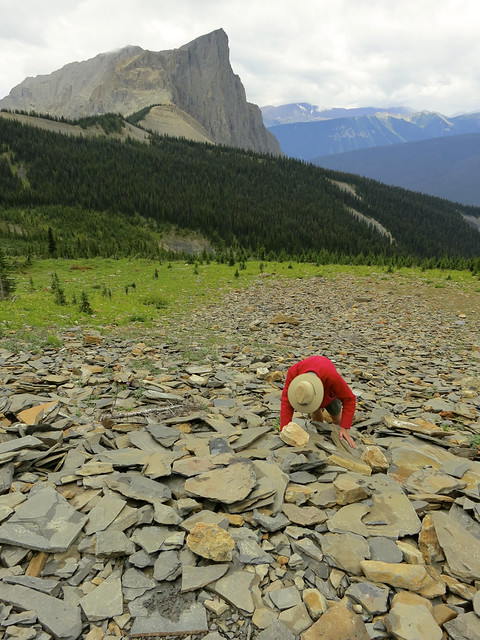
The Williston Lake Tracksite. Image from the Indiegogo campaign page.
Time is of the essence; not all of our fellow citizens respect prehistoric sites. To save the tracks from vandals and profiteers, the team at PRPRC needs to document the site fully. This is where we all come in. Via the crowdfunding platform Indiegogo, the museum is raising funds to engage in fieldwork at the site. The effort is represented online by palaeontologist Lisa Buckley, who you may know from her blog and Twitter. She graciously agreed to an interview about this campaign, the importance of ichnology in general, and the fossil heritage of British Columbia.
To start, can you give a brief introduction to the field of ichnology to readers who may be unfamiliar?
Ichnology, for its basic definition, is the study of any traces left by an organism: burrows, trails, borings, footprints, bite marks, nests... it's the study of how a moving, breathing, living organism interacts with, reacts to, and shapes its environment. It's another window into the lives of extinct organisms. In terms of dinosaurs, which is vertebrate ichnology (study of traces left by vertebrates), it tells us what the animals actually did while they were alive: it compliments what we know from skeletal paleontology. Skeletons give us what the animals looked like and what they might be capable of doing, and ichnology tells us what they did do... as long as it fossilizes.
What was your path to ichnology?
I was first seriously introduced to ichnology when I went up to Tumbler Ridge in the summer of 2003 to help colleague (and now fellow researcher at the Peace Region Palaeontology Research Centre) Rich McCrea. That summer we were working on British Columbia's first dinosaur bone excavation, but he had been researching dinosaur footprints in the Peace Region since the mid 1990s. On days when we were not on the dig site, he showed me the dinosaur footprints sites in the region. It fascinated me the amount of information that could be gathered from footprints, and how, like modern animal footprints, you can use those footprints to identify what animals were in the area. For a province like British Columbia that was historically dinosaur bone poor but dinosaur footprint rich, these footprints provided the ONLY records for what dinosaurs once lived in BC.
My personal research focus is now a blend of skeletal anatomy and ichnology. My doctoral thesis is looking at the correlations between bird foot anatomy and the skeletal features that can possibly show up in bird footprints. Being introduced to trace fossils has given me a much better appreciation for fossils as living organisms with habits, environmental preferences, and complex behaviors.
Stepping back a bit further, what experiences first sparked an interest in natural history when you were younger?
I have to thank my great-aunt Molly for my interest in natural history. She was always interested in natural history, but growing up in the Depression in a poor family made it impossible for her to go to college. Regardless, she read everything she could find on dinosaurs, prehistoric mammals, and flying reptiles. I remember her telling me that they very first book she had the money to buy when she was 12 was a dinosaur book. One of my earliest memories of her is from when I was preschool age, and she was reading to me from a book on extinct mammals. She was showing me the pictures of Eohippus, the saber-toothed cats, and the giant ground sloths. I must have asked her "how do they know these were real?" because she told me that we know about these animals because people dig them up and study them, and I knew then that was what I wanted to do. Molly is the reason I'm doing what I do today. She has since passed away, but she was alive to see me enter the field of paleontology and help establish the Peace Region Palaeontology Research Centre, and I kept her updated on all of our discoveries. I am very happy I had that opportunity.

The Burgess Shale Discovery Site by Edna Winti, licensed under CC BY 2.0.
Most of us will be familiar with the Burgess Shale - what other important palaeontological sites are in BC?
I'll admit I had a bit of a chuckle regarding "most people being familiar with the Burgess Shale" - I have no doubt that most paleontologists, paleoartists, and paleo-enthusiasts (and readers of your blog!) are familiar with the Burgess Shale, but when I ask people not involved with paleontology if they have ever heard of the amazing Burgess Shale fossils near Yoho, it comes as a complete surprise to them! Fossils haven't been part of BC's cultural heritage in the same way that they are in Alberta, and it has taken some time and a lot of public outreach to introduce people to BC's fossil heritage. Slowly but surely we are making progress!
Here are the top five sites that pop in my mind when I think of significant fossil sites in BC. A classic BC fossil locality is Wapiti Lake Provincial Park. In this park are outcrops of Triassic-age marine deposits, and this is from where our classic Triassic marine fish like Bobasatrania, Albertonia, Birgeria, and the iconic coelacanth are recovered, along with marine reptiles like ichthyosaurs and thalattosaurs. Andrew Wendruff described an entirely new family, genus, and species of coelacanth, Rebellatrix divaricerca, from collections we made from other Wapiti Lake-equivalent outcrops in other parts of the Peace Region. This story is great because the holotype specimen was discovered by a (then) 11 year old girl who used to live in Tumbler Ridge.
With marine reptiles in mind, the Pink Mountain site is from where the late Dr. Elizabeth Nicholls with the Royal Tyrrell Museum recovered the giant ichthyosaur Shastasaurus sikanniensis. That site is in the BC Peace Region near Fort St. John. That ichthyosaur is a monster of a beast!
Turning back to dinosaurs, we are planning for continuing our excavation of BC's first (mostly) complete dinosaur skeleton. This is Late Cretaceous in age (late Campanian-early Maastrichtian), and it is a site that contained an articulated skeleton of a lambeosaurine hadrosaur. The helicopter airlift of the skeleton is featured in Episode 2 of "Dino Hunt Canada". We need to return to that site, because in 2013 we discovered that there is more than one skeleton preserved. We may be dealing with a hadrosaur bonebed.
One of my favorite sites is the BC tyrannosaur tracksite. The site is late Campanian - early Maastrichtian in age, and shows three beautifully preserved trackways of the same type of large theropod, walking in the same direction and roughly spaced evenly from one another. The sediment even preserved skin impressions with the footprints. This paper came out in PLoS One in 2014 (A Terror of Tyrannosaurs). Preserved at this site are more beautifully preserved footprints of hadrosaurs, medium-sized theropods, and ankylosaurs. This is another track surface that needs excavating: all of the tyrannosaur trackways continue on the track surface under a steep, high hill. We need to expose more of that track surface to see what other tyrannosaur behaviors might be preserved.
Last but not least, we have the dinosaur tracksites from within the boundaries of the newly established Tumbler Ridge Global Geopark. We have an impressive range of dinosaur track-bearing rocks ranging from 140 million years old to 73 million years old. That's 67 million years of dinosaur history in BC, and for a great deal of geologic time in western Canada, for which there is a sketchy body fossil record. Every terrestrial formation we have examined within the Geopark boundaries contains footprints from vertebrates, which gives us a great picture of how dinosaur communities were changing from the Early Cretaceous to the Late Cretaceous in western Canada.

A detail of the tracksite, featuring large bird tracks. Photo from the campaign page.
What about the new site, Williston Lake Tracksite, excites you most?
The Williston Lake Tracksite represents something that we never thought we would have the opportunity to do, and that's return to the start of dinosaur paleontology in British Columbia. Dinosaur tracks were first documented from the Peace River Canyon near the community of Hudson's Hope in 1930 by Charles M. Sternberg. The tracks were from the Gething Formation (around 115 million years old, Early Cretaceous) and in 1932 he named several new footprint types from the Peace River Canyon: small-, medium-, and large-sized theropod tracks, ornithopod tracks, and one of our favorites, Tetrapodosaurus borealis, ankylosaur tracks. This was the first ever description of an ichnofauna (a relationship of footprints and footprint-making animals in an environment) for Cretaceous footprints. Anyone working on Cretaceous footprints needs to refer back to Sternberg's 1932 works. It would be better still if they could visit the localities of these prints, but they can't - no one can.
Although the Province of British Columbia granted the Peace River Canyon tracksites Provincial Heritage Resource status (the highest protective status available at the time) in 1930, all of these historically and scientifically important tracksites were flooded when the Peace River Dam went online in 1979. All of these sites are now entombed under what is now called Dinosaur Lake. There was a huge salvage effort done between 1976-1979 by the Provincial Museum of Alberta (now the Royal Alberta Museum), but no where near all of the tracks could be saved.
The Williston Lake Tracksite is the first large track-bearing surface from the Gething Formation that has been exposed in 36 years. This site is the closest thing we have to revisiting the classic Sternberg localities, and the first chance we've had to seriously update Sternberg's 1932 track descriptions using footprints from the same formation and in the same region. We never thought we would have the opportunity in our lifetimes to continue Sternberg's work in this formation.
Do you know the approximate age of the new tracksite, or if it preserves the same ichnofauna as Sternberg's site?
The new tracksite is from the Gething Formation, which is approximately 115 million years old. This is the same formation that Sternberg documented. From what is exposed at the site, we can see that some of the ichnofauna Sternberg documented and named are present: we see the large theropod prints Irenesauripus, and the ankylosaur prints Tetrapodosaurus. So far this is what we would expect to see from the Gething Formation, but there is only a small portion of the tracksite exposed right now. The exciting finds will happen when we uncover large surfaces and examine them in detail. Personally, I'm hoping for more bird footprints from the Gething Formation! Aquatilavipes (small shorebird) was described by Currie in 1981, and we recovered Limiavipes (large wading bird) from close to the area in 2005. The Early Cretaceous was a hotbed for shorebird diversity in Asia - I want to see how similar (or different!) the bird footprint diversity was in similarly-aged deposits in North America.
The Williston Lake trackway is certainly a fossil site worthy of proper study. I love the fact that the team at PRPRC is working with the local community to secure the location, including plans to build an interpretive center at the site. The financial mountain the team has to climb is a tall one, though - see the project budget detailed at Indiegogo. So please share this interview and links to the campaign page far and wide. And, of course, donate as you are able. Thanks to Lisa for taking the time to answer my questions. I wish the team the best of luck in reaching their goal!
Fast forward another few decades, when a new, extensive tracksite was discovered by a local resident - a resident who thankfully appreciated the importance of the site to our shared natural heritage. They reported the discovery to the researchers at the Peace Region Palaeontology Research Centre who were excited to begin documenting the first major tracksite in the province since Sternberg's sites were lost.

Time is of the essence; not all of our fellow citizens respect prehistoric sites. To save the tracks from vandals and profiteers, the team at PRPRC needs to document the site fully. This is where we all come in. Via the crowdfunding platform Indiegogo, the museum is raising funds to engage in fieldwork at the site. The effort is represented online by palaeontologist Lisa Buckley, who you may know from her blog and Twitter. She graciously agreed to an interview about this campaign, the importance of ichnology in general, and the fossil heritage of British Columbia.
To start, can you give a brief introduction to the field of ichnology to readers who may be unfamiliar?
Ichnology, for its basic definition, is the study of any traces left by an organism: burrows, trails, borings, footprints, bite marks, nests... it's the study of how a moving, breathing, living organism interacts with, reacts to, and shapes its environment. It's another window into the lives of extinct organisms. In terms of dinosaurs, which is vertebrate ichnology (study of traces left by vertebrates), it tells us what the animals actually did while they were alive: it compliments what we know from skeletal paleontology. Skeletons give us what the animals looked like and what they might be capable of doing, and ichnology tells us what they did do... as long as it fossilizes.
What was your path to ichnology?
I was first seriously introduced to ichnology when I went up to Tumbler Ridge in the summer of 2003 to help colleague (and now fellow researcher at the Peace Region Palaeontology Research Centre) Rich McCrea. That summer we were working on British Columbia's first dinosaur bone excavation, but he had been researching dinosaur footprints in the Peace Region since the mid 1990s. On days when we were not on the dig site, he showed me the dinosaur footprints sites in the region. It fascinated me the amount of information that could be gathered from footprints, and how, like modern animal footprints, you can use those footprints to identify what animals were in the area. For a province like British Columbia that was historically dinosaur bone poor but dinosaur footprint rich, these footprints provided the ONLY records for what dinosaurs once lived in BC.
My personal research focus is now a blend of skeletal anatomy and ichnology. My doctoral thesis is looking at the correlations between bird foot anatomy and the skeletal features that can possibly show up in bird footprints. Being introduced to trace fossils has given me a much better appreciation for fossils as living organisms with habits, environmental preferences, and complex behaviors.
Stepping back a bit further, what experiences first sparked an interest in natural history when you were younger?
I have to thank my great-aunt Molly for my interest in natural history. She was always interested in natural history, but growing up in the Depression in a poor family made it impossible for her to go to college. Regardless, she read everything she could find on dinosaurs, prehistoric mammals, and flying reptiles. I remember her telling me that they very first book she had the money to buy when she was 12 was a dinosaur book. One of my earliest memories of her is from when I was preschool age, and she was reading to me from a book on extinct mammals. She was showing me the pictures of Eohippus, the saber-toothed cats, and the giant ground sloths. I must have asked her "how do they know these were real?" because she told me that we know about these animals because people dig them up and study them, and I knew then that was what I wanted to do. Molly is the reason I'm doing what I do today. She has since passed away, but she was alive to see me enter the field of paleontology and help establish the Peace Region Palaeontology Research Centre, and I kept her updated on all of our discoveries. I am very happy I had that opportunity.

Most of us will be familiar with the Burgess Shale - what other important palaeontological sites are in BC?
I'll admit I had a bit of a chuckle regarding "most people being familiar with the Burgess Shale" - I have no doubt that most paleontologists, paleoartists, and paleo-enthusiasts (and readers of your blog!) are familiar with the Burgess Shale, but when I ask people not involved with paleontology if they have ever heard of the amazing Burgess Shale fossils near Yoho, it comes as a complete surprise to them! Fossils haven't been part of BC's cultural heritage in the same way that they are in Alberta, and it has taken some time and a lot of public outreach to introduce people to BC's fossil heritage. Slowly but surely we are making progress!
Here are the top five sites that pop in my mind when I think of significant fossil sites in BC. A classic BC fossil locality is Wapiti Lake Provincial Park. In this park are outcrops of Triassic-age marine deposits, and this is from where our classic Triassic marine fish like Bobasatrania, Albertonia, Birgeria, and the iconic coelacanth are recovered, along with marine reptiles like ichthyosaurs and thalattosaurs. Andrew Wendruff described an entirely new family, genus, and species of coelacanth, Rebellatrix divaricerca, from collections we made from other Wapiti Lake-equivalent outcrops in other parts of the Peace Region. This story is great because the holotype specimen was discovered by a (then) 11 year old girl who used to live in Tumbler Ridge.
With marine reptiles in mind, the Pink Mountain site is from where the late Dr. Elizabeth Nicholls with the Royal Tyrrell Museum recovered the giant ichthyosaur Shastasaurus sikanniensis. That site is in the BC Peace Region near Fort St. John. That ichthyosaur is a monster of a beast!
Turning back to dinosaurs, we are planning for continuing our excavation of BC's first (mostly) complete dinosaur skeleton. This is Late Cretaceous in age (late Campanian-early Maastrichtian), and it is a site that contained an articulated skeleton of a lambeosaurine hadrosaur. The helicopter airlift of the skeleton is featured in Episode 2 of "Dino Hunt Canada". We need to return to that site, because in 2013 we discovered that there is more than one skeleton preserved. We may be dealing with a hadrosaur bonebed.
One of my favorite sites is the BC tyrannosaur tracksite. The site is late Campanian - early Maastrichtian in age, and shows three beautifully preserved trackways of the same type of large theropod, walking in the same direction and roughly spaced evenly from one another. The sediment even preserved skin impressions with the footprints. This paper came out in PLoS One in 2014 (A Terror of Tyrannosaurs). Preserved at this site are more beautifully preserved footprints of hadrosaurs, medium-sized theropods, and ankylosaurs. This is another track surface that needs excavating: all of the tyrannosaur trackways continue on the track surface under a steep, high hill. We need to expose more of that track surface to see what other tyrannosaur behaviors might be preserved.
Last but not least, we have the dinosaur tracksites from within the boundaries of the newly established Tumbler Ridge Global Geopark. We have an impressive range of dinosaur track-bearing rocks ranging from 140 million years old to 73 million years old. That's 67 million years of dinosaur history in BC, and for a great deal of geologic time in western Canada, for which there is a sketchy body fossil record. Every terrestrial formation we have examined within the Geopark boundaries contains footprints from vertebrates, which gives us a great picture of how dinosaur communities were changing from the Early Cretaceous to the Late Cretaceous in western Canada.

What about the new site, Williston Lake Tracksite, excites you most?
The Williston Lake Tracksite represents something that we never thought we would have the opportunity to do, and that's return to the start of dinosaur paleontology in British Columbia. Dinosaur tracks were first documented from the Peace River Canyon near the community of Hudson's Hope in 1930 by Charles M. Sternberg. The tracks were from the Gething Formation (around 115 million years old, Early Cretaceous) and in 1932 he named several new footprint types from the Peace River Canyon: small-, medium-, and large-sized theropod tracks, ornithopod tracks, and one of our favorites, Tetrapodosaurus borealis, ankylosaur tracks. This was the first ever description of an ichnofauna (a relationship of footprints and footprint-making animals in an environment) for Cretaceous footprints. Anyone working on Cretaceous footprints needs to refer back to Sternberg's 1932 works. It would be better still if they could visit the localities of these prints, but they can't - no one can.
Although the Province of British Columbia granted the Peace River Canyon tracksites Provincial Heritage Resource status (the highest protective status available at the time) in 1930, all of these historically and scientifically important tracksites were flooded when the Peace River Dam went online in 1979. All of these sites are now entombed under what is now called Dinosaur Lake. There was a huge salvage effort done between 1976-1979 by the Provincial Museum of Alberta (now the Royal Alberta Museum), but no where near all of the tracks could be saved.
The Williston Lake Tracksite is the first large track-bearing surface from the Gething Formation that has been exposed in 36 years. This site is the closest thing we have to revisiting the classic Sternberg localities, and the first chance we've had to seriously update Sternberg's 1932 track descriptions using footprints from the same formation and in the same region. We never thought we would have the opportunity in our lifetimes to continue Sternberg's work in this formation.
Do you know the approximate age of the new tracksite, or if it preserves the same ichnofauna as Sternberg's site?
The new tracksite is from the Gething Formation, which is approximately 115 million years old. This is the same formation that Sternberg documented. From what is exposed at the site, we can see that some of the ichnofauna Sternberg documented and named are present: we see the large theropod prints Irenesauripus, and the ankylosaur prints Tetrapodosaurus. So far this is what we would expect to see from the Gething Formation, but there is only a small portion of the tracksite exposed right now. The exciting finds will happen when we uncover large surfaces and examine them in detail. Personally, I'm hoping for more bird footprints from the Gething Formation! Aquatilavipes (small shorebird) was described by Currie in 1981, and we recovered Limiavipes (large wading bird) from close to the area in 2005. The Early Cretaceous was a hotbed for shorebird diversity in Asia - I want to see how similar (or different!) the bird footprint diversity was in similarly-aged deposits in North America.
The Williston Lake trackway is certainly a fossil site worthy of proper study. I love the fact that the team at PRPRC is working with the local community to secure the location, including plans to build an interpretive center at the site. The financial mountain the team has to climb is a tall one, though - see the project budget detailed at Indiegogo. So please share this interview and links to the campaign page far and wide. And, of course, donate as you are able. Thanks to Lisa for taking the time to answer my questions. I wish the team the best of luck in reaching their goal!
Subscribe to:
Posts (Atom)