Though I'd gone to the Bird House on my
first trip to the National Zoo, I'd not visited the numerous outdoor bird exhibits surrounding it. Besides, I needed to get more photos from the Bird House itself, and you can never have too much of dinosaurs.
A spectacled owl preening itself.
Some barred owls.
Stanley cranes foraging very close to the wire mesh of their exhibit (which was,
as usual with cranes, quite unnerving). I got a good look at their highly reduced halluces (present in cranes in general), though that may or may not be visible from my photo. And that's right, depictions of cranes perching in trees are inaccurate!
A wattled crane.
A kori bustard, the heaviest flying bird alive. I'm photographing much of this through mesh, by the way. Did I say I got a little bit better at photographing through mesh?
Yes, yes I did.A white stork with crested screamers. Screamers are closely related to ducks, by the way, but you probably wouldn't be able to tell just by looking at them. They also have
large spurs on their wings that grow back easily if broken off.
A whooping crane.
Some king vultures, among the most magnificent of these magnificent birds.
A red-legged seriema, which also happens to be one of fellow
Hell Creek member Rudyspino's favorite denizens of this zoo. (I was going to say his favorite, but I'm not so sure now that he's seen the ravens, which I'll talk about in a future post.) Seriemas are the closest living relatives to terror birds and are predatory, though on this day it was just being cute. (Then again, many smaller-bodied predators also happen to be very cute.)
A blue-billed curassow.
A scarlet ibis with roseate spoonbills in the background.
A large flock of flamingos.
A rhea.
An emu (one of the occasions where my photographing-through-mesh skills deteriorated).
There was an outdoors walkthrough aviary with a nice variety of birds. The zoo puts most of the birds here away from November to April, so it's best to visit during the other half of the year (May to October). There are several ponds in the aviary for waterfowl, among them mandarin ducks, wood ducks, and hooded mergansers.
Some blue-winged teal.
A presumably wild chipmunk foraging in the aviary. It's been so long since I've come to the East that eastern chipmunks, northern cardinals, blue jays, and northern mockingbirds are all exciting sightings for me.
A female Temminck's tragopan.
And nearby was the male.
A pair of Indian peafowl were also in close proximity (though not close enough for me to get photos of the two at the same time - alright, I probably could have if I'd actually tried).
Another pond, mostly inhabited by hooded mergansers at this point.
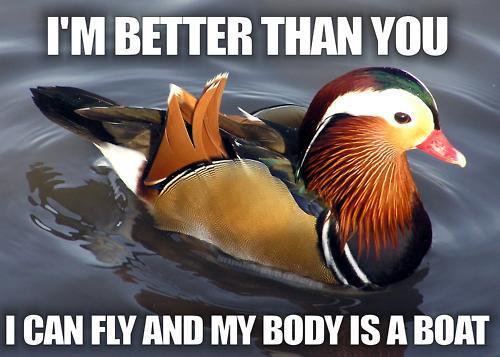
I consider diving ducks right up there with
auks as some of the most enjoyable animals to watch at zoos. Consider the following meme:
And now recall that a diving duck is a flying boat that can
also transform into a submarine.
Some white-faced ibises.
A blue-crowned motmot inside the Bird House itself.
Some white-faced whistling ducks.
Some swamp sparrows. As New World "sparrows", they aren't actually sparrows, but are closer to buntings. (Conversely, North American "buntings" are not true buntings, but are closer to cardinals.) Even so, being used to seeing
house sparrows (which are true sparrows) hopping around, it was mildly surprising to see these running while on the ground instead.
Some crested oropendolas.
A pair of red-fan parrots allopreening.
Guam kingfishers with a fellow Micronesian refugee, a Guam rail.
The guira cuckoos were huddled together among some plants this time.
Some blue-crowned hanging parrots, so called due to their habit of hanging upside down to sleep (which I unfortunately didn't get to see).
The keel-billed toucan, sadly without its
iguana companion.
A much better picture of a Socorro dove than my
previous attempt.
A mottled owl.
A burrowing owl.
The Bird House has an indoor walkthrough aviary at its center, which I'd gone to last time but neglected to mention (or take photos of). Here's an Asian fairy bluebird (right) with something else I didn't notice until after I'd taken the photo and am now having trouble identifying!
A green-winged macaw.
A sunbittern.
And yes,
kiwis still hate me.