Showing posts with label Year end review. Show all posts

Review of 2016

Despite being one of my busiest years yet, last year was in some ways a success for this blog, as I blogged more in 2016 than in any previous year since 2010 (the year Raptormaniacs was created). If anything, the frequent travel that I did helped me produce more content for the blog: I went to New York to visit a temporary exhibit on bird origins, to South Dakota to attend field camp, to London for TetZooCon, to Utah for SVP, and to Bristol to study. It was not all just filler on here, however, given that I released the longest (and some might say most bizarre) storyline for the Raptormaniacs comic to date. Well, I enjoyed making it. The flip side of all this is that I largely neglected the Tumblr sideblog, but something had to give. Lastly, April Fools' happened, as usual.

Cover image for the "My Little Raptormaniacs" storyline.

Enough about me, you're more likely here for the new maniraptor discoveries. In January, eggshell previously attributed to Genyornis was reinterpreted as belonging to Progura. Quill pits were reported from an Eocene penguin. The genome of the great tit was sequenced. Carotenoid-based feather coloration was found in pink-headed ducks. Great reed warblers were suggested to sing outside of the breeding season to practice their songs. Forty-spotted pardalotes were found to stimulate manna production in eucalyptus trees for feeding. New studies came out on body mass of dodos, the cranial biomechanics of moa, the kicking strike of secretary birds, vocal learning in zebra finches, and the evolution of bill length in 'amakihi, melanin-based coloration system in birds, and chromosomes in white-throated sparrows. Newly-named maniraptors included the non-ornithothoracine avialan Chongmingia zhengi, the Eocene stem-falcon Antarctoboenus carlinii, the enantiornithine Linyiornis amoena, the Cretaceous euornithines Dingavis longimaxilla (which I find suspiciously similar to Juehuaornis) and "Bellulia" rectusunguis (with its genus preoccupied, it would receive a new name later in the year), and the Himalayan forest thrush (Zoothera salimalii).
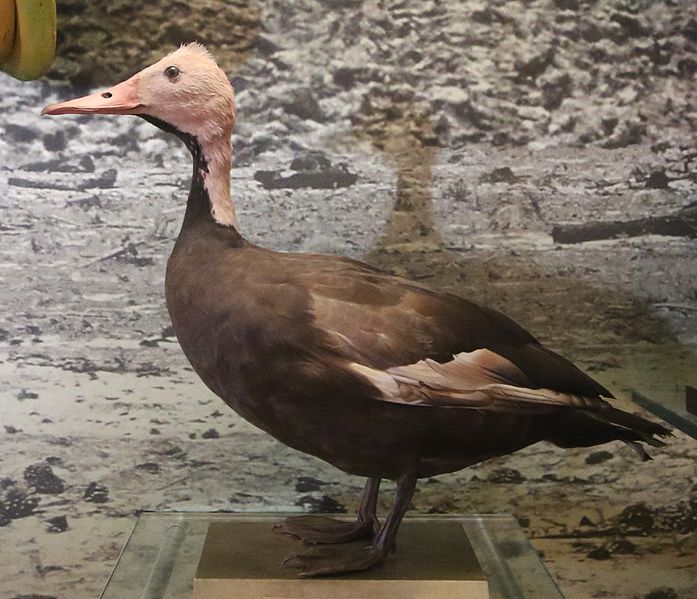
Mounted specimen of a pink-headed duck, photographed by "Geni", licensed.

In February, duetting in red-backed fairy wrens was found to deter cuckoldry (among themselves, not among their listeners...). Evidence for a theory of mind in common ravens was presented. A specimen of Hesperornis was found with injuries attributed to a plesiosaur attack. New specimens of Archaeorhynchus and Chambicuculus were described. "Furculae" assigned to Dakotaraptor were reinterpreted as turtle entoplastra. New studies came out on the development of fibular reduction in birds, the endocranial anatomy of dodos, the evolution of sexually dimorphic tail feathers, the feather structure of Humboldt penguins, and sound recognition in European starlings. Newly-named maniraptors included the presbyornithid Wilaru prideauxi, the dromornithid Dromornis murrayi, and a bizarre possible maniraptor of uncertain placement, Fukuivenator paradoxus.
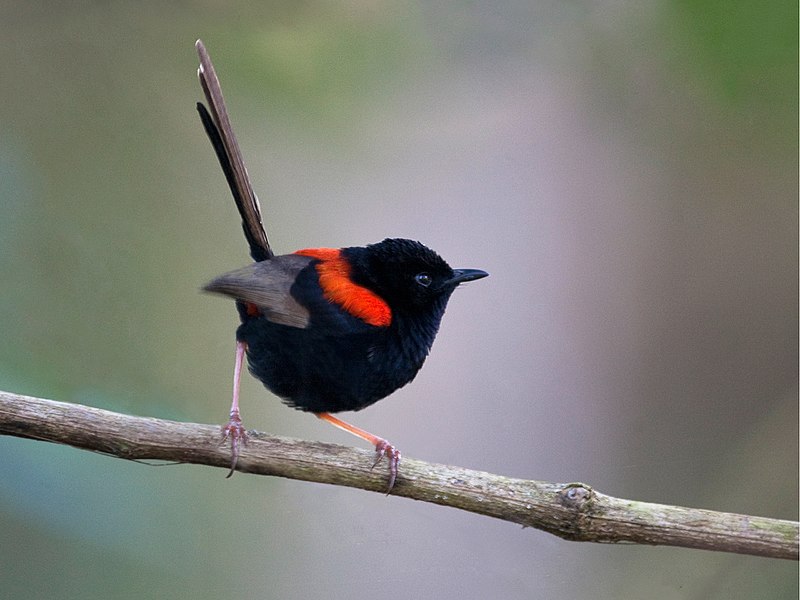
Red-backed fairy wren, photographed by Greg Miles, licensed.

In March, brown skuas were reported to be capable of recognizing individual humans. Compositional syntax was found in the calls of great tits. The bill morphology of New Caledonian crows was shown to facilitate tool use. Vocal learning was discovered in red-backed fairy wren embryos. New studies came out on the evolution of color in island birds, the development of feathered feet in domestic chickens and pigeons, the migratory biology of ruby-throated hummingbirds, the vision of small passerines, the morphology of dodos, the mandibular anatomy of Segnosaurus, the tarsometatarsal anatomy of ostriches, the mechanics of sound production in the wings of Smithornis broadbills, and the phylogenetic position of Sylviornis. Newly-named maniraptors included the Cretaceous euornithines Hesperornis lumgairi and Changzuiornis ahgmi, the Eocene apodiform Cypseloramphus dimidius, and an Eocene bird of uncertain placement, Lapillavis incubarens.

Skeletal reconstruction of Sylviornis, from Worthy et al. (2016).

In April, island birds were found to predictably evolve decreased flying ability. Golden-collared manakins and red-capped manakins were discovered to use superfast forelimb muscle contractions during social displays. Vocal mimicry in female superb lyrebirds was reported. The reproductive biology of the sapayoa was described. A new enantiornithine specimen was found to have fish remains as gut contents. New studies came out on the rates of morphological evolution in Early Cretaceous birds, the effect of diet on avian evolution, the taxonomy of geranoidids from the Willwood Formation, the migration strategies of pied flycatchers, brain activity during flight in European starlings, self-regulation in corvids, dental disparity in paravians prior to the K-Pg, the genetic basis for beak size in Darwin's finches, the history of Australian penguins, the biomechanics of courtship displays in Indian peafowl, the evolution of skull shape in raptorial birds, and the ontogeny of limb kinematics in chukars. Newly-named maniraptors included the oviraptorosaur Apatoraptor pennatus and the plotopterids Klallamornis abyssa and Olympidytes thieli.

Red-capped manakin, photographed by Francesco Veronesi, licensed.

In May, the genetic basis for red coloration in birds was described. Research on the phylogeography of the vermilion flycatcher species complex resulted in the recently-extinct San Cristóbal vermilion flycatcher being declared a distinct species. The bill of southern yellow-billed hornbills was found to function in thermoregulation. Hybridization in geese was reviewed. New studies came out on the phylogeny of geese, the structural mechanics of the feather vane, polymorphism in black sparrowhawks, the pelvic limb musculature of ostriches, the evolution of bone-associated genes in birds, duetting displays in magpie larks, and the shape recognition in African gray parrots.

Diagram showing that the enzyme CYP2J19 converts yellow carotenoids to red carotenoids in birds, from Lopes et al. (2016).

In June, wings of juvenile enantiornithines were found preserved in amber. Sexual dimorphism was found in Dromornis stirtoni. Birds were discovered to have higher neuronal density in their forebrains than mammals. Budgerigars and zebra finches were reported to learn grammatical structure in different ways. New studies came out on cognitive development in kaka, the function of nocturnal song in field sparrows, the genetic bases of beards and muffs in chickens, the vascular anatomy of bird heads, the evolution of communal signaling in birds, the chemistry of Troodon tooth enamel, and the osteology of Bathornis. Newly-named maniraptors included the lithornithid Calciavis grandei. "Bellulia" rectusunguis was given the new genus Bellulornis.

Wing of juvenile enantiornithine preserved in amber, from Xing et al. (2016).

In July, great frigatebirds were found to track atmospheric conditions during transoceanic flights. Feather keratin was suggested to be durable enough to be potentially fossilized. The capacity for flapping-based locomotion in Mesozoic paravians was evaluated. New Caledonian crows were reported to use tools for carrying objects. Relational concept learning was demonstrated in ducklings. New studies came out on the consumption of blister beetles by male great bustards, the preservation of avian fossils, visual pigments in emus, interspecies communication between greater honeyguides and humans, visual guidance of flight in hummingbirds, genomic variation in Darwin's finches, and the evolution of ultraviolet vision, closed-mouth vocalizations, skull morphology, and locomotion in birds. Newly-named avialans included the Pleistocene cuckoos Centropus bairdi and Centropus maximus and the Miocene gypaetine vulture Mioneophron longirostris.

Ducklings imprinted on a set of differently-shaped objects (A) prefer a novel set of differently-shaped objects over a novel set of identically-shaped objects (C), whereas ducklings imprinted on a set of identically-colored objects (B) prefer a novel set of identically-colored objects over a novel set of differently-colored objects (E)... though sometimes mistakes are still made (D), from Martinho and Kacelnik (2016).

In August, tool-bending behavior was found to be common in New Caledonian crows. Great frigatebirds were confirmed to sleep in flight. Barbados bullfinches and Carib grackles were discovered to be capable of passing the string-pulling test. The evolution of avian reproduction was reviewed. Zebra finches were found to sing to their unhatched chicks to prepare them for hot weather. New studies came out on the phylogenetic position of the laughing owl, the timing of the crown-penguin radiation, genomic variation in the yellow-rumped warbler species complex, and the diversification of kiwis and passerines. Birds of Stone by Luis Chiappe and Meng Qingjin was published and my review of it can be found here.

Great frigatebird, photographed by "Aviceda", licensed.

In September, pigeons were found to be able to distinguish words from non-words. They were also found to prefer informative over non-informative options and to ignore misinformed leaders. The development of feathers was reviewed. Tool use was reported in Hawaiian crows. Melanin in feathers was elementally characterized. A hard polytomy was argued to be present at the root of Neoaves. Pellets possibly produced by Eocene owls were described. European blackbirds were discovered to switch abruptly to nocturnal flight during migration. New studies came out on the phylogeny of New World vultures, the function of nasal conchae in turkeys, non-vocal signaling during courtship displays in blue-capped cordon bleus, song complexity in pied butcherbirds, the genetic bases for vision in raptorial birds, the morphology of tracheal and esophageal displacement in birds, the development of the grasping foot in birds, and the dentitions of Hesperornis and Ichthyornis. Newly-named maniraptors included the Eocene stem-roller Septencoracias morsensis, the Dahomey forest robin (Stiphrornis dahomeyensis), the Ghana forest robin (Stiphrornis inexpectatus), and the Rudder's forest robin (Stiphrornis rudderi).

Hawaiian crow using stick as probing tool, from Rutz et al. (2016).

In October, red flight feathers in yellow-shafted flickers was found to be caused by diet rather than by hybridization with red-shafted flickers. A preserved syrinx was reported from a specimen of Vegavis. A bonebed of Avimimus was described at last after having been rumored at conferences for many years. Evidence was presented in favor of treating the hen harrier and northern harrier as distinct species. A parrot fossil was reported from the Miocene of Russia. Common swifts were discovered to spend ten months in the air annually. Migratory life histories were found to explain the extreme size dimorphism in Eudyptes penguin eggs. New studies came out on altruism in azure-winged magpies, the relationships between flight style and avian wing aerodynamics, the timing of the columbiform radiation, the mechanics of plunge diving in sulids, and the evolution of the avian bill as a thermoregulatory organ. Newly-named maniraptors included the Pleistocene owl Bubo ibericus, the Eocene owl Eostrix gulottai, and the Eocene albatross Notoleptos giglii. Avian Evolution by Gerald Mayr was published and my review of it can be found here.

Preserved Vegavis syrinx, from Clarke et al. (2016).

In November, an immature enantiornithine specimen was inferred to have had iridescent feathers. Keratin preservation was reported in the claws of Citipati and the feathers of Eoconfuciusornis (alongside melanosomes in the latter case). A new estimate argued that there are around 18,000 species of extant birds. Goffin's cockatoos were reported to be capable of manufacturing tools out of different materials. The microstructure of an isolated feather from the Fur Formation was analyzed. Interhemispheric transfer of imprinting information was found to be absent in the brains of newly-hatched ducklings. New studies came out on the morphology of Chiappeavis, the evolution of avian breeding strategies, and the timing of the origins of avialans and neornithines. Newly-named maniraptors included the enantiornithine Monoenantiornis sihedangia, the oviraptorosaur Tongtianlong limosus, the Miocene galliforms Eurobambusicola turolicus and Mioryaba magyarica, and the zygodactylids Primozygodactylus longibrachium and Primozygodactylus quintus.

Holotype of Tongtianlong limosus, from Lü et al. (2016).

In December, laser fluorescence was used to study the soft tissues of Confuciusornis. A new juvenile specimen of Sapeornis was described, revealing dentary teeth to have been present in this taxon. "Liornis" and Callornis were reevaluated. Complexities in the evolution of avian flight were discussed. New studies came out on the flight parameters of Mesozoic avialans, the histology of cranial joints in mallards, the comparative morphometrics of Darwin's finches and Hawaiian honeycreepers, the evolution of avian genomes and paleognaths, the morphology of the jugal and quadratojugal in maniraptors, the relationships between body feather structure and habitat, and the influence of wing morphology on dispersal in corvoids. Newly-named maniraptors included the Cretaceous euornithine Tingmiatornis arctica.

Confuciusornis specimen photographed under laser fluorescence, from Falk et al. (2016).

Review of 2015

It was a busy year and the Tumblr suffered for it, but, considering that I didn't end up blogging significantly less than I did last year, I'm reasonably satisfied with what I did on here. Jurassic World came out this year, causing much discussion in the paleontological community. I have nothing to add about the film that has not already been said, but its release did give me the prompt to finish up another story arc for the comic. My travel destinations this year included New York, Osaka, and Dallas, the last of which hosted the first SVP conference I've attended. Additionally, I indulged in some frivolous nonsense, including a Twitter meme and the obligatory April Fools' post.

Cover image for the "Triassic Park" storyline.

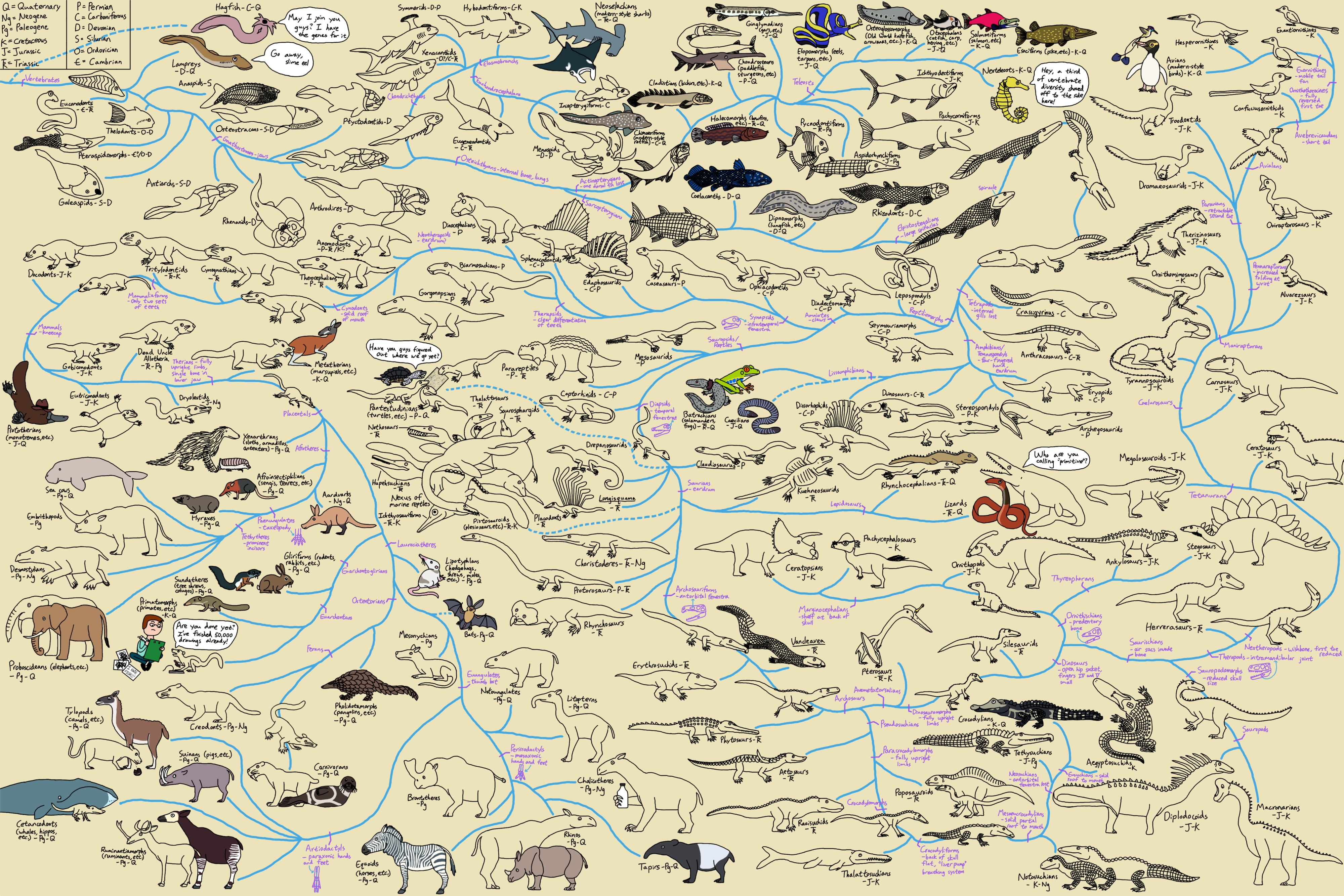
Though not directly related to the blog, the unexpected stardom of my Cartoon Guide to Vertebrate Evolution, which I drew this past summer, is worth a mention. It is by far my most popular work on DeviantArt (in terms of number of favorites and comments), has been made available on merchandise by popular request, earned me interviews with Terp Magazine and the National Center of Science Education, and has reportedly been used in presentations at academic conferences. Wow.

The Cartoon Guide to Vertebrate Evolution.

Onward to new maniraptor discoveries of the past year. In January, newborn chickens were found to mentally map numbers the same way humans do. New material of Caenagnathus and Elmisaurus was described. Linheraptor was argued to represent a separate taxon from Tsaagaan. New studies came out on emberizoid phylogeny and seed dispersal by emus. Newly-named maniraptors included the Eocene trogon-like avialan Foshanornis songi and the enantiornithine Houornis caudatus (formerly a species of Cathayornis).

Chicks trained to circumnavigate panels displaying a target number of identical elements (A), showing a preference for the left panel when navigating past numbers smaller than the target number (B) and for the right panel when navigating past numbers larger than the target number (C), from Rugani et al., 2015.

In February, altruistic behavior among northern bald ibises flying in V-formation was reported. The genomes of Darwin's finches were sequenced. Caenagnathasia was reported from the Iren Dabasu Formation for the first time. Male peafowl were discovered to use infrasonic signals during courtship. A trade-off was found between sexual attractiveness and parental effort among male grassquits. The postcranial anatomy of Gansus was described. New studies came out on the phylogeny of Todiramphus kingfishers and harriers, the body mass of Mesozoic avialans, the barb geometry of asymmetric feathers in Mesozoic paravians, the loss of taste in penguins, the mechanics of avian feet during perching and grasping, the craniocervical myology of Falcarius and Nothronychus, and the evolution of gastralia and sterna in paravians. Newly-named maniraptors included the Miocene heron Nyctisoma robusta.

Male Indian peafowl displaying, photographed by Nihal Jabin, licensed.

In March, purportedly distinct redpoll species were found to have largely undifferentiated genomes. The blue-bearded helmetcrest, once thought extinct, was rediscovered alive. Natural selection and sexual selection were discovered to operate on different axes of variation in avian plumage color. New studies came out on the origin of crown passerines and the phylogenetic position of the mandanga and the São Tomé shorttail. Newly-named maniraptors included the enantiornithines Dunhuangia cuii and Yuanjiawaornis viriosus, the Cretaceous euornithine Juehuaornis zhangi, the phorusrhacid Llallawavis scagliai, and the Perijá tapaculo (Scytalopus perijanus).

Phylogeny of motacillids showing the mandanga and the São Tomé shorttail as members of the clade, from Alström et al., 2015.

In April, new ecological information for the black tinamou was reported. A new specimen of Longipteryx was described. Transoceanic migration in blackpoll warblers was documented. New studies came out on the size of the gastral basket in Mesozoic paravians and the ontogeny of Deinonychus. Newly-named maniraptors included the scansoriopterygid Yi qi, which preserved evidence of membranous wings, a contender for the most unexpected dinosaur discovery of at least the past decade.

Holotype of Yi qi, from Xu et al., 2015.

In May, evidence of nest site fidelity in troodonts was described. Contagious yawning in budgerigars was reported. The trace fossil Wupus agilis was argued to represent a large avian footprint. New studies came out on the function of the alula in flight, the development of the avian snout and hallux, the phylogeny of hesperornithines, the evolution of sexual dimorphism in wood warblers, differences in exploration behavior of carrion crows and common ravens, and the safekeeping of tools by New Caledonian crows. Newly-named maniraptors included the dromaeosaurid Saurornitholestes sullivani, the Cretaceous euornithine Archaeornithura meemannae, and the Sichuan bush warbler (Locustella chengi).

Chicken experimentally induced to develop snout morphology similar to the ancestral amniote condition, compared to a typical chicken ("control") and an alligator, from Bhullar et al., 2015.

In June, the osteology of Nothronychus was described in detail. Rapid head rotation was found to help lovebirds maneuver quickly. Correlation was found between avian altriciality and toe orientation. The pelvic limb musculature of the ostrich was modeled. New specimens of Masillapodargus and Tonsala were described. Brown thornbills were discovered to mimic a chorus of alarm calls to dissuade nest predators. An egg once thought to belong to a ceratopsian was reevaluated as an enantiornithine egg. Several purported stem parrots were reconsidered and found to have been stem passerines. New studies came out on the phylogenetic position of Balaur, the bone histology of Aepyornis, convergence in feather crests of domestic doves, the evolution of sternal ossification in ornithothoracines, ontogenetic shape change in the chicken brain, and mimicry in female cuckoo finches. Newly-named maniraptors included the enantiornithines Cratoavis cearensis, Holbotia ponomarenkoi (a longtime nomen nudum), and Parapengornis eurycaudatus.

Brown thornbill, photographed by J.J. Harrison, licensed.

In July, roosters were found to crow in sequence based on their social rank. The genome of the North Island brown kiwi was sequenced. The helmeted woodpecker, once thought to belong to Dryocopus, was found to be a species of Celeus. Newly-named maniraptors included the oviraptorosaur Huanansaurus ganzhouensis, the dromaeosaurid Zhenyuanlong suni, and the Miocene condor Kuntur cardenasi.

Holotype of Zhenyuanlong suni, from Lü and Brusatte, 2015.

In August, hummingbird tongues were reported to function as micropumps. Canaries were discovered to be flexible in the timing of learning songs. Blue-footed boobies were found to use behaviorally-induced camouflage to hide their eggs. New studies came out on chemical defense in common cuckoo chicks, opisthotonic head displacement in chickens, the endocranial anatomy of Eocene stem penguins, the ultrastructure of Anchiornis feathers (supporting identification of preserved microbodies in the fossil feathers as melanosomes), the diversification of avians across the K-Pg boundary, and inference by exclusion in Goffin's cockatoos. Newly-named maniraptors included the enantiornithine Pterygornis dapingfangensis.

Amazilia hummingbird tongue filling with (dyed) nectar, from Rico-Guevara et al., 2015.

In September, king penguins were found to be able to distinguish odors of conspecifics. Zebra finches were discovered to pick mates based on behavioral compatibility. Black-chinned hummingbirds were reported to nest in association with Accipiter hawks to increase breeding success. Mated pairs of southern rockhopper penguins were found to winter in separate locations. Brown-headed cowbirds were shown to select hosts in response to reproductive success. American crows were discovered to gather around dead conspecifics as a means of learning about danger. New studies came out on bone histology of penguins, the emergence of social rank in monk parakeets, and the function of colored beak spots in king penguins. Newly-named maniraptors included the Pleistocene barn owl Tyto cravesae and the flightless Pleistocene duck Shiriyanetta hasegawai.

Southern rockhopper penguin, photographed by Stan Shebs, licensed.

In October, a well-preserved enantiornithine wing was described. Recent advances in research on bird origins was reviewed. Kleptoparasitism in gentoo penguins was reported. New studies came out on cooperation in common ravens, the evolution of body mass in pan-alcids and wing shape in avians, the phylogeny of neornithines, the morphology of penguin feathers, and the relationship between skeletal and total body mass in birds. Newly-named maniraptors included the Miocene shorebird Hakawai melvillei and the large dromaeosaurid Dakotaraptor steini.

Phylogeny of neornithines, from Prum et al., 2015.

In November, a supergene was found to be responsible for divergent male morphs in ruffs. Blue-capped cordon bleus were reported to use a tap-dancing courtship display. Pigeons were discovered to assume leadership based on speed. Zebra finches were observed negotiating vocally over parental care. Cerebavis was reevaluated and found to be a euornithine. New studies came out on the function of hindlimb feathers in Mesozoic paravians, the evolution of avian brain modularity, the hindlimb myology of moa, the social network dynamics of New Caledonian crows, and the foraging behavior of great tits. Newly-named maniraptors included the hesperornithine Fumicollis hoffmani, the plotopterid Stemec suntokum, and Paragallinula, a new genus for the lesser moorhen.

Male ruffs in breeding plumage, photographed by Arjan Haverkamp, licensed.

In December, spontaneous tool use in greater vasa parrots was reported. Asymmetric limb control during bipedal locomotion in guineafowl was described. New studies came out on heat dissipation in calliope hummingbirds, locomotion in large ground birds, hook tool use in New Caledonian crows, cervical pneumatization in ostriches, structural color in Eurasian jay feathers, and the diversification of neornithines. Newly-named maniraptors included the possible dromaeosaurid Boreonykus certekorum, the enantiornithines Feitianius paradisi and Chiappeavis magnapremaxillo, the Eocene possible suliform Mangystania humilicristata, and the extinct Holocene rails Rallus adolfocaesaris, Rallus carvaoensis, Rallus lowei, "Rallus minutus" (preoccupied), and Rallus montivagorum.

Greater vasa parrot, photographed by AEM, licensed.

Review of 2014

I am still far from being a regular blogger (and I have no issue with that), but I have at last broken the trend of increasingly shirking the blog with each passing year. On the other hand, I posted significantly less on the Tumblr in 2014 than in 2013. (There was, in fact, a greater absolute number of posts on the Tumblr last year, but the average concentration of posts per month was far lower.) This was, at least in part, due to the fact that I was working on a story arc for the comic over the summer months, something I have not done since the first year of this blog. The basic concept for that story had been drifting in my mind for at least a couple years, so it was good to get it out of my system. While that translated to my falling behind on answering Tumblr questions, it was also an important contributor to last year's increased post count on here. Circumstances permitting, there is more to come.

In retrospect, I did quite a large amount of traveling over the past year (to New York, Arizona, Tokyo, and Ohio), which further added to the blog post boost. In spite of long periods of stagnation on the comic (per usual), I continued to receive fan art, for which I am immensely grateful. Last but not least, I did not forget about April Fools'.

Cover image for the "Turn to Stone" storyline.

What's new with maniraptors? I don't yet foresee a year where the answer will not be "Lots!" In January, new specimens of Hongshanornis, Pengornis, and (the possibly raptorial) Bohaiornis were described. A review on bird behavior in the fossil record was published. The enigmatic paravian Zhongornis, known only from a juvenile specimen, was suggested to be a scansoriopterygid, but there are reasons to be suspect of this result. A hoatzin from the Miocene of Kenya was reported. Powered flight was found to have driven the reduced genome size of birds. Falcons were discovered to pursue prey using visual motion cues. New studies came out on the benefits of V-formation flight, the aerodynamics of Microraptor, and timing the origin of neornithines. Newly-named maniraptors included the enantiornithines Parvavis chuxiongensis, Parabohaiornis martini, and Longusunguis kurochkini, the troodont Gobivenator mongoliensis, the Eocene hoatzin Protoazin parisiensis, and the Paleocene avialan Australornis lovei.

The skull of Gobivenator mongoliensis, from Tsuihiji et al., 2014.

In February, mutualism was documented between green-backed firecrown hummingbirds and cryptogamic plants. The pale eyes of jackdaws were found to function in deterring intruders. Chickens with artificial long tails were used to study how non-avian dinosaurs might have walked. Brown thornbills were reported to mimic different alarm calls in response to different threats. Isotopic evidence was used to support the notion that Gastornis, frequently portrayed as a fearsome predator, was probably herbivorous. New studies came out on avian forelimb development, the evolution of melanosomes in maniraptors and other feathered dinosaurs (which also discovered that the feathers of Caudipteryx may have been black), the aerodynamics of diving flight in peregrine falcons, the relationship between avian ecology and caudal skeletal morphology, and the efficiency of lift generation in common swifts.

Experimental design of chicken walking study, from Grossi et al., 2014.

In March, great tits were reported to deliberately withhold information from competitors. The mechanisms of color production in the plumage of male Lawes's parotia were described. Retaliatory behaviors by avian brood parasites were found to be promoted by plastic defensive behavior in their hosts. Another study showed that there are circumstances under which a host can benefit from brood parasites. The reconstruction of colors from fossilized pigments that has been a growing field these past few years was questioned, suggesting that supposed fossil pigments are really traces of bacteria. There were multiple presentations on both sides of this controversy at the SVP conference later in the year, so little doubt there will be much more to say about this subject in the near future. New studies came out on the phylogenetic position of the spotted wren babbler, causal understanding in New Caledonian crows, and the extinction of moas. Newly-named maniraptors included the Pliocene penguin Eudyptes calauina and the long-awaited large caenagnathid Anzu wyliei, too late for the oviraptorosaur-heavy 2013 but very much welcome.

Skeletal reconstruction and fossil material of Anzu wyliei, from Lamanna et al., 2014.

In April, visual effects of bowers built by great bowerbirds were described. The interpretation of Archaeopteryx as having had elongate covert feathers was disputed. Field observations of the rare black-throated blue robin were published. New specimens of Yanornis were described. New studies came out on the diversification of hummingbirds, the growth of Gargantuavis, the ability of birds to learn structural efficacy of nesting material, the understanding of social relations among common ravens, quantification of feather wettability, and the running performance of bar-headed geese under low oxygen conditions.

Phylogeny of hummingbirds, from McGuire et al., 2014.

In May, flexible alarm mimicry by fork-tailed drongos was published (which had been previously filmed in the 2013 BBC documentary series Africa). The braincase of Nothronychus and the jaw musculature of the laughing kookaburra were described, as was a new specimen of Zhouornis. Long-axis rotation was found and quantified in avian bipedal locomotion. An extremely well-preserved griffon vulture fossil specimen with soft tissues was reported. Pseudaptenodytes macraei was redescribed. Pumiliornis was found to have eaten pollen. Hoopoe eggshells were discovered to enhance adhesion of symbiont-carrying secretions. New studies came out on the function of therizinosaur claws, paleognath phylogeny, the development of feather asymmetry, the evolution of WAIR, and the post-fledging dispersal of king penguins. Newly-named maniraptors included the confuciusornithiform-like Cretaceous pygostylian Evgenavis nobilis, the Cretaceous euornithine Tianyuornis cheni, the Eocene gruiform Galligeranoides boriensis, and the possibly scansorial enantiornithine Fortunguavis xiaotaizicus.

Virtual cast of exceptionally-preserved griffon vulture fossil, from Iurino et al., 2014.

In June, "Saurornitholestes" robustus was reevaluated as a troodont. Eurasian jays were found to use acoustic cues to pilfer the caches of others. The Wakatobi flowerpecker was re-split from the gray-sided flowerpecker. The possibility of finding carotenoid pigments in feathers preserved in amber was evaluated. New studies came out on the bite performance of loggerhead shrikes, the identification of Euryapteryx moa chicks, the population fluctuations of passenger pigeons, the genomic landscape underlying the carrion-hooded crow complex, the evolution of avian egg patterns, elaborate signals in tanagers, and carotenoid-pigemented plumage, the leap and strike kinetics of barn owls, and the development of zygodactyl feet. Newly-named maniraptors included Spizelloides, a new genus for the American tree sparrow.

Wakatobi flowerpecker (right column) compared to gray-sided flowerpecker (left column), from Kelly et al., 2014.

In July, an excellent new specimen of Archaeopteryx was described. (This paper additionally coined the name Pennaraptora for the least inclusive clade containing oviraptorosaurs and paravians, a term we had been sorely in need of.) Anatomical change through ontogeny in chickens was documented in detail. Ichthyornis was reported from Mexico for the first time. New material of Itemirus was described, supporting the idea that it was a dromaeosaurid, though skepticism exists about this assignment and conclusion. New material representing very large specimens was also described for Palaeeudyptes. The oldest known avian eggshell, hailing from the Early Cretaceous, was reported. New studies came out on the wing dynamics and efficacy of hovering hummingbirds, the vocal repertoire of African penguins, and the evolution of the modern avian tail. Newly-named maniraptors included the pelagornithid Pelagornis sandersi (one of the largest known flying birds), the microraptorian Changyuraptor yangi, and the Miocene duck Bambolinetta lignitifila (formerly a species of Anas), while the Miocene stem albatross Chenornis was sunk into Plotornis.

New specimen of Archaeopteryx, from Foth et al., 2014.

In August, sustained miniaturization in avian evolution was supported. Aerial righting behavior was documented in juvenile chukar, suggesting yet another possible function for incipient wings. No evidence for attraction to shiny objects in magpies was concluded by one study. New studies came out on tinamou phylogeny, the evolution of migration in New World songbirds, sweet taste perception in hummingbirds, and the semilunate carpal in theropods, and the coevolution of the avian caudal skeleton and tail feathers (with implications for reconstructing the tail feathers of extinct birds). Newly-named maniraptors included the enantiornithine Grabauornis lingyuanensis.

Aerial righting behavior in juvenile chukar, from Evangelista et al., 2014.

In September, social transmission of tool use was documented in Goffin's cockatoos. The Rodrigues solitaire was digitally reconstructed. Anchiornis and Sapeornis were argued to lack sterna. The elaborate tail plumage of peacocks was found to not hinder their ability to take off. New studies came out on the evolution of avian wrist bones and rates of evolution in coelurosaurs (including maniraptors).

Evolution of wrist bones in theropods, from Botelho et al., 2014.

In October, great antshrikes were reported to have learned to use tools in order to prey on invasive land snails. The Eocene paleognath Palaeotis was restudied. Long-billed hermit hummingbirds were found to have sexually dimorphic bills used as weapons by the males. Extreme nomadism in banded stilts and prenatal learning in superb fairy wrens were documented. The skull anatomy of Haplocheirus was described. Male great bustards were shown to consume more poisonous foods than females do. Running birds were discovered to prioritize leg safety on uneven terrain. New studies came out on cotinga phylogeny, the diversification of crown-group rails, the aerodynamics of Microraptor (again), ontogenetic scaling in the hindlimb muscles of greater rhea, the expansion of ostriches into India, and the function of wing tucks in steppe eagles. Newly-named maniraptors included the enantiornithine Eopengornis martini, the Cretaceous euornithine Iteravis huchzermeyeri, and the basal avialan Jeholornis curvipes (the holotype specimen of which was initially going to be described in a different manuscript).

Long-billed hermit hummingbird, photographed by Kradlum, licensed.

In November, the cranial anatomy of Erlikosaurus was described. Brood parasitism was elicited in zebra finches by nest destruction. The osteohistology of Hesperornis and pygoscelid penguins was compared. Juvenile cinereous mourners were reported to mimic toxic caterpillars. New specimens of Scaniacypselus were published. New studies came out on the evolution of avian egg shape, the microbiome of New World vultures, and the function of cassowary casques. Newly-named maniraptors included the Pliocene vulture Aegypius varswaterensis, the Cretaceous euornithine Gansus zheni (which, as it turns out, is probably the same as Iteravis), and the Sulawesi streaked flycatcher (Muscicapa sodhii).

Juvenile cinereous mourner (left) and contemporaneous toxic caterpillar (right), from Londoño et al., 2014.

In December, a massive paper drop landed on our heads as the numerous findings of the Avian Phylogenomics Project were simultaneously published. Hummingbirds were found to control hovering flight by stabilizing visual motion. New cultural traditions were experimentally introduced to great tits. The endocranium of Conchoraptor was redescribed. Bird tracks were reported from the Cedar Mountain Formation for the first time. Spontaneous analogical reasoning in crows was documented. The white-faced ground sparrow was split from the Prevost's ground sparrow. New material of Microraptor (used a couple years ago to reconstruct its plumage coloration) and Caenagnathasia was described. New studies came out on wing versus leg investment in birds and the anatomy and ontogeny of paleognath hindlimbs.

Phylogeny of extant birds based on whole genome analysis, from Jarvis et al., 2014.