Being fit and healthy is important for a long and happy life! Get latest news, videos and photos on health, physical fitness, body fitness, fitness tips, fitness band.
This Wednesday, October 11, is National Fossil Day in the US, during which science organizations around the country hold paleontology outreach events. The National Park Service and partner organizations are holding a major Fossil Day event on the National Mall in Washington, DC. To see what events are happening near you, see the list from Sarah Gibson at PLOS Paleo Community (parts one and two).
Just over a week ago, I was contacted by David Polly, president of the Society of Vertebrate Paleontology, to design some Fossil Day outreach materials. The SVP wanted to commission a set of trading cards highlighting six amazing dinosaur discoveries at Utah's Grand Staircase-Escalante National Monument. I was thrilled to get the gig and pitched the idea of doing something colorful, graphic, and fun. Dr. Polly had a list of taxa in mind, so I started sketching. A few days later, the art was given the thumbs up and the cards went into production! This was one of the quickest project turnarounds I've ever worked on, and I'm totally pleased with the end result.
"Beasts of the Grand Staircase" trading cards, designed by David Orr of Blue Aster Studio for the Society of Vertebrate Paleontology. Photo by David Polly.
This project was special for a few reasons. First of all, this was the first time I was commissioned by the SVP to create something, and that's something of a dream come true. Second, ceratopsids are a heck of a lot of fun to draw, and this set was half ceratopsid! Third, I was very happy to draw Utahceratops gettyi; many of you may already know that the species' namesake, Mike Getty, passed away tragically a few weeks ago. I never had the chance to meet him, but I've appreciated the fond tributes from folks in the paleontology community whose life he impacted. And finally, the protection of public lands is an issue close to my heart, and they are in peril. We need to raise up a grassroots effort to defend these precious places.
Thank you to Dr. Polly for bringing me aboard this outreach effort. Learn more information about the DC event on the SVP news page. The SVP is also distributing a flyer I designed featuring the card art for all to share. Have a great National Fossil Day, everyone!
Illustrator, designer, and herpetologist Gabriel Ugueto's prolific output never ceases to stun me - a feeling Natee also shares, as the subject came up during our recent meeting. You may recall that Gabriel's posters of various families of non-avian dinosaurs were included in our 2016 gift guide, and may also recognize him as part of the Studio 252mya paleoart team.
Lately, Gabriel has been following up his previous series by designing posters based on various geological formations and the paleofauna they've revealed to us. Laid out phylogenetically, they offer a concise way to take stock of select groups of inhabitants of each of these paleoenvironments. Animals are shown in easy-to-understand lateral and dorsal views, occasionally with details like alternate views of the head with jaws agape. Each poster also includes a helpful scale diagram.
As someone who especially enjoys learning about prehistoric animals in context with their contemporaries, I really appreciate this undertaking - and it doesn't hurt that Gabriel's illustrations are beautiful and his layouts are attractive and easy to digest. The posters are available at Gabriel's Redbubble shop; links in the image captions above will take you directly to each poster's shop listing. Keep an eye out for his next design, dedicated to the Oxford Clay.
Follow Gabriel on Twitter, Redbubble, ArtStation, and Instagram, where he often shares works-in-progress and close-ups of individual animals - as well as a selfie game so fierce he handily earns the title #Paleobae. Thanks to Gabriel for allowing me to share his work here, now let's get them up on some walls!
“Dinosaurs have intentionally been left out of this book to give some attention to less popular – but still fascinating – creatures that once lived on this planet.”
Thus begins Maja Säfström’s Animals of a Bygone Era: An Illustrated Compendium, a new book that I suspect will be of great interest to this blog’s readers, dinosaurs or no. Besides, Maja’s not technically correct – there are some wonderful avian dinosaurs that made the cut. And there are plenty of Mesozoic relations of the dinosaurs proper.
The aesthetic is simple, but indirect. Säfström approaches her subjects with more of an eye for their alien charm than for strict fidelity to their anatomy. Rendered in stark black and white, with great attention paid to textural, patterned line work, her animals will appeal to those of you who appreciate a fanciful take on paleoillustration. There’s a cock-eyed, occasionally Seussian quality to the work that I find eminently appealing.
Säfström’s writing is plain-spoken, jargon-light, and witty, with some of the jokey dialogue given to her creatures reminding me of Rosemary Mosco’s Bird and Moon comics. “Wings are overrated – look at my beak instead. It’s huge! Best Regards, Terror Bird,” says a terror bird. The educational content varies from simple facts like the size of the eyes of Opthalmosaurus or the diet of Gigantopithecus to brief references to changing paleontological viewpoints on oddballs like Helicoprion.
No book is without small sins, of course (take it from me, the knucklehead who messed up the extinction date of the mammoths). The biggest one I saw here was the repetition of the old canard that the giant azhdarchids’ flight capabilities were questionable, but this just gives Säfström the opportunity to discover the glory that is Wittonalia.
Small quibbles like that do not take away from the value of this book, which is populated by a wide array of often-overlooked prehistoric animals. Säfström lovingly introduces readers to such animals as Synthetoceras, Nuralagus rex, Coryphodon, Sharovipteryx, Pteraspis, and Macrauchenia. At the risk of alienating myself from present company, there were even animals here I’d never heard of, such as the “horned gopher” Ceratogaulus.
I’ve seen an upswing of interest in highly stylized paleoillustration online lately, much of this thanks to Johan Egerkrans’ stunning pieces recently shared with the Paleoartists group on Facebook. While more surreal than Egerkrans' work, I imagine there could be a healthy crossover between the two artists’ fan base. As someone who primarily works in this vein, it’s heartening to see support for such work, and I hope that Animals of a Bygone Era finds its audience.
Not the roller coaster that March was, but April's been another nifty month in matters paleontological, and that's no foolin'!
In the News
Edmontosaurus lovers, heads up. The cranium of E. regalisis the subject of a new paper in PLoS One. Brian Switek has been writing a cool series called "The Dead Zoo" for Omni, and he profiled the mighty duckbill, taking into account all of this new information we've been getting about it over the last decade.
Herman's back with a book review attack, upping one that rocks, dissing one that lacks. Hit it!
At Tyrannosauroidea Central, Thomas Carr writed about the implications of the recent publication of Daspletosaurus horneri: ontogeny and the anagenesis hypothesis.
The Royal Tyrrell Museum's speaker series continues, with a presentation on the halisaurine mosasaurs by Dr. Takuya Konishi of the University of Cincinnati.
Brian Engh revisits Aquilops in his newest paleoart video.
Crowdfunding Spotlight
Following up her portrait series on the diversity of the paleontology community, Thea Boodhoo is working on organizing a workshop on diversity at this August's SVP meeting in Calgary. They need funds to make the workshop a great experience for all attendees. Head to GoFundMe to help out.
After her successful set of prehistoric enamel pins funded a couple months ago, Jessy Smith is back with a set of Mesozic megafauna. Pledge at Kickstarter.
Just a quick note: there's one week left to respond to the 2017 Survey of Paleoartists. If you missed my earlier post on the survey, please read it to learn more. And head to bit.ly/paleoartsurvey to take it! It will only take a few minutes, and is relevant for hobbyist and professional alike.
A look at the results so far is pretty interesting, and I look forward to publishing what we find out. So far, we've had 331 respondents from 33 countries. If you're a paleoartist, please add your voice, and share the link far and wide.
Recently, there has been some back-and-forth on Facebook about what capital-P paleoart is, as John Conway proposed some guidelines for the Paleoartists group. While certain genres of dinosaur art - for instance Jurassic Park fan art - aren't too hard to rule out, other forms are a harder call. The group has been debating whether fantastical pieces based on close anatomical study of ancient life are allowable. Others have mused about how stylized something can be and still count as paleoart. I've certainly wondered that about Mammoth is Mopey. And it's a balancing act we've played at LITC, for instance with our 2013 All Yesterdays competition. But while we may debate the place and the value of Rigorous Paleoart vs. "mere" illustrations of prehistoric life, I think we can all agree that it's good for pop culture to be permeated with more depictions of prehistoric beasts based on contemporary paleontology.
This leads us to the subject of today's post. As I was traipsing through the dinosaur realms of DeviantArt recently, I came across a wonderful stylized Amargasaurus illustration by Tanya Kozak, AKA Virsiris. It looked like it could have been a still from a dinosaur cartoon I'd definitely watch. The description said that the illustration was part of Stomping Grounds, a dinosaur art zine. I followed the link to Gumroad and picked up a copy. It's sold on a pay-what-you-want scheme.
Released about a year ago,Stomping Grounds couldn't be simpler in its execution. It is focused solely on illustration, without any text besides credits for the creators. I'd have appreciated a bit of background information on the species and the artist's rationale for each illustration, and I'd think it would justify a bump up from pay-what-you-want to a set price to cover the additional layout work required.
The zine is decidedly not filled with capital-P paleoart, but that's not the intent. This is a celebration of dinosaurs. Kozak invited a range of artists, many of whom work in animation, to contribute. So it's not surprising that the art bursts with character, like Squeedge's slavering Cryolophosaurus in pink plumage or Kari Fry'sDracorex standoff. My personal favorite was Neogeen'sTroodon flock, dramatically rendered in red and drab green, all fully feathered. More than any other piece in the collection, Neogeen's suggests a wider world and I'd love to see it stretched out into a comic or animated piece. Kozak, whose Amargasaurus led me to the zine in the first place, has a few pieces in the zine, with standouts like a fierce Mosasaurus , a Carnotaurus with subtly but effectively exaggerated features, and a fuzzy, ready-for-cartoon-villainy Dilophosaurus.
The zine is well worth picking up and throwing a few buck the artists' way. It's heartening to see artists who aren't scientific illustrators continuing to absorb the good news of our current paleontological golden age. Head to Gumroad to download for free or name your price.
A line of people snakes through the north entryway, populated mostly by locals taking advantage of a promotion offering free entry for state residents. From the middle of a group of twentysomethings, I hear a man's voice express mild disappointment as he peers past the ticket counters at the famous tyrant dinosaur beyond.
"I thought she'd be bigger."
"Just wait 'til you're below her," I respond.
Queen Sue. Photo by David Orr.
After attending the Wild Things conference this weekend, conversing with all sorts of people about conservation and urban ecology in the Midwest US, I grabbed the chance to visit the Field Museum.
The Field is one of my favorite places to spend a day indoors. In a previous post, I did a walkthrough of the Field's dinosaur hall (with more photos here). I thought that this time, I might aim a more critical eye at the exhibit, especially concerning the role of paleoart. Due to the heavy weekend crowd, I didn't even try for exhaustive documentation, but I think I got enough to be worth sharing here, and I'll supplement with some of my older photos. I'd also recommend Ben Miller's thoughtful walkthrough and review of the entire Evolving Planet exhibit at Extinct Monsters.
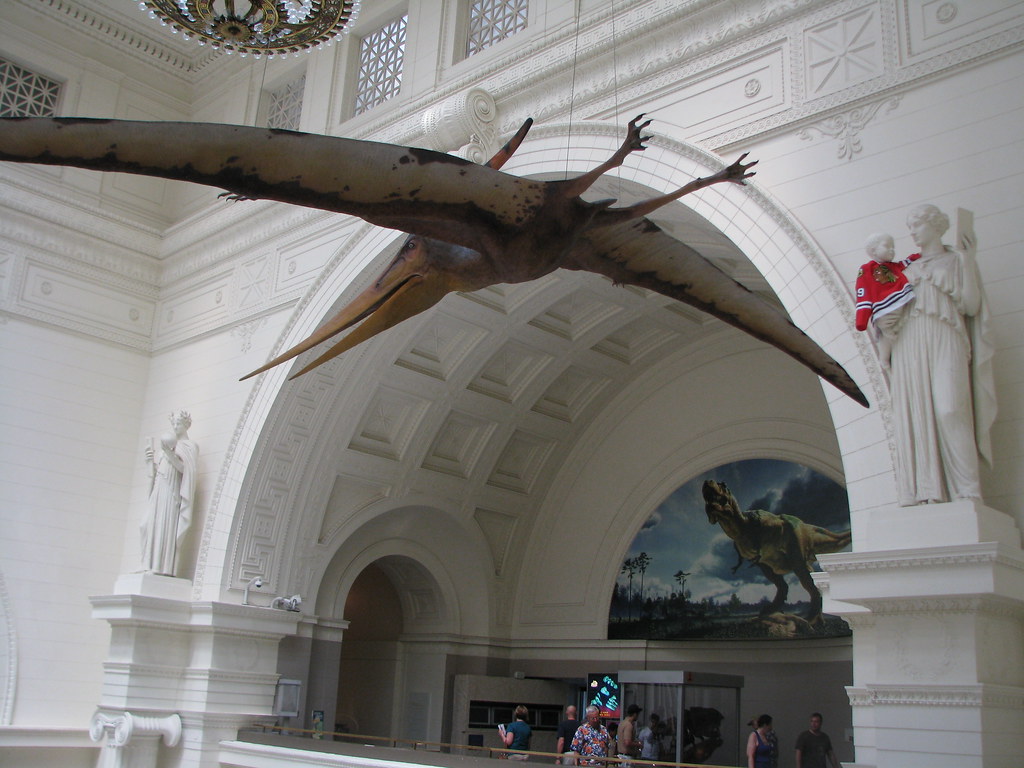
A Pteranodon model with the John Gurche "Sue" mural in the background.
The most visible pieces of 2-D paleoart in the Field are the Charles R. Knight murals, mounted high around the perimeter of the dinosaur hall as well as select positions along the exhibit's length. They surely deserve prominent display (the first paleoart visitors encounter would be Gurche's Sue mural overlooking the queen herself). I would love to see more contemporary artists given more prominence. Perhaps a revisit of classic Knight scenarios and compositions, with information given about the evolution of ideas in the last century of paleontological study.
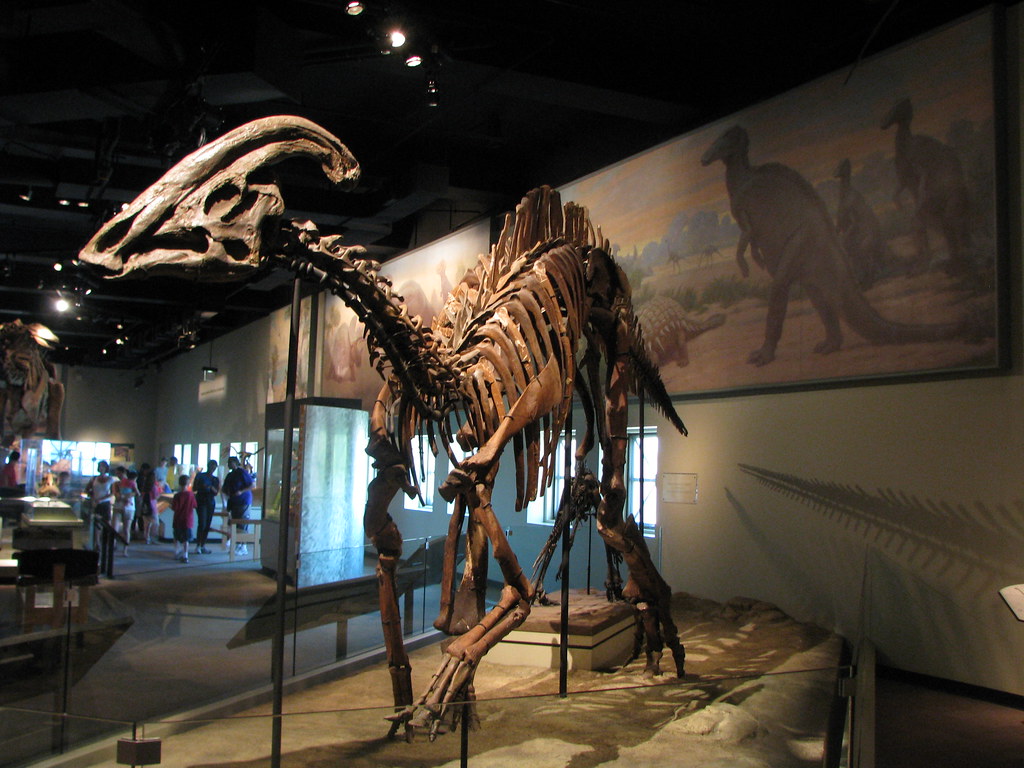
Daspletosaurus mount with classic Knight Tyrannosaurus v. Triceratops in the background.A mount of Parasaurolophus with retro Knight hadrosaurs in the background.Pteranodon skeletal model with retro Tylosaurus and Archelon in the background.
Is that sacrilege? Maybe it is, but for the collection's importance to the history of paleoart, these pieces arguably work at cross-purposes to the content of the exhibit. In Evolving Planet, aside from "how do we know this?" passages on informational panels intended to counter creationist prejudices visitors may bring with them, the story of the science isn't foregrounded.* So it's a bit counterproductive to have so much antiquated scientific illustration present, without equally prominent discussion of how the science has progressed. In a museum where space is at a premium, it may be a pipe dream, but it's a pipe dream I like.
This is not to say that the art's vintage is entirely unremarked upon: for instance, Knight's place in the history of the science is called out in one of the informational panels, opposite the Stegosaurus mount.
Charles R. Knight's Stegosaurus
The exhibit isn't entirely devoid of newer art. The didactic panels accompanying fossil mounts include serviceable, if sometimes shrink-wrappy, occasionally GSP-posed, illustrations of the animals.
Illustration of Edmontonia, in a familiar pose.Illustration of a skinny-necked Rapetosaurus juvenile.
There's no information on the artist. The style is sometimes too airbrushy, which doesn't do much for me personally.
Illustration of StegocerasMajungatholus, er, Majungasaurus illustration.
Some of the panels also include cladistic diagrams, which are helpful to ground the animals in their evolutionary context. There's even an explanation of what a cladogram is, and tough words like "Marginocephalians." Contrast this with a panel earlier in the exhibit, in which the Ediacaran biota is referred to simply as the "earliest animals." Such concision is understandable. But the amount of fine-grain information provided in the dinosaur hall implicitly confirms a visitor's idea that these animals are of the utmost importance.
Sauropod cladogram, with a scrawny-necked Apatosaurus in the middle.Marginocephalian cladogram, featuring Triceratops. Protoceratops, and Anchiceratops illustrations. No pachycephalosaurs for you!.
In the small pocket of the hall dedicated to the evolution of birds, casts of Archaeopteryx and Sinornis fossils are accompanied by fully feathered models, as well as illustrations of Deinonychus and Sinornithosaurus in the old-school, grudgingly feathered mode.
"Evolving Planet" is a great exhibit, and one I recommend to anyone visiting Chicago. Attentive visitors will definitely walk out of it with new knowledge of and appreciation for evolutionary history. Though this post may seem a bit nit-picky, it was valuable for me to visit with the intention of doing more than ogling the mounts one more time. After all, the exhibit turns 11 this year. It's reached the age of the exhibit it replaced, "Life Through Time." So it's only natural that it is starting to show its age. I think it's a good time to imagine the next form a paleontological exhibit may take at the Field. My wishlist? More on bird evolution in the dinosaur hall. And throughout, more contemporary paleoart integrated with displayed fossil specimens, more on the stories of how discoveries have been made and how they've enriched our understanding of life's history.
But hey, you can't complain too much when Tiktaalik is at the party.
Living on an island devoid of giant theropods, Hatzegopteryx was an azhdarchid pterosaur that acheived a status few of its brethren could hope for: top terrestrial predator. Read more about this "shoebill-hornbill-terminator" from Mark Witton and Brian Switek.
How long did non-avian dinosaurs incubate? New research looks into the question by studying growth lines in the teeth of Protoceratops and Hypacrosaurus embryos, among other methods. Their conclusion is that it's likely that the rapid incubation we see in living dinosaurs is a later development, and most Mesozoic dinosaurs developed slowly. Read more from Carolyn Gramling for Science and NPR.
Around the Dinoblogosphere
At Aeon, Alex Riley writes about recent efforts to understand what prehistoric worlds sounded like, touching on Vegavis, Parasaurolophus, and the bush cricket Archaboilus musicus.
Rebor has released three Deinonychus replicas as part of a larger Acrocanthosaurus and Tenontosaurus diorama, and they are quite lovely. Check out Everything Dinosaur's post on the set. Now, I look forward to the alternate universe version, in which a Tenontosaurus triumphantly bellows a victory song atop a heap of fallen theropods it has bested.
Lisa Buckley, inspired by some proselytizing door-knockers, decided to start making science-oriented pamphlets to hand out when the need arises, starting her "Science Tracks" series with OMFG Birds are Great!
How does one keep up with the ever-increasing amount of paleontological research? At the SVP blog, Dr. Darin Croft has some advice.
At Paleo-King, Nima brings our attention to an article from 2015 that reports the results of a paleoart survey of 115 paleontologists (of whom 100 responded). The article, published in Current Trends in Paleontology and Evolution, had the goal of creating a working definition of paleoart. One question was for respondents to identify paleoartists whose work they recognized, with interesting results (Doug Henderson and Greg Paul each had only 5 mentions apiece). It would be interesting to see this performed with a larger sample size and with more international participation: Spain accounted for 70% of the respondents. Direct PDF link here.
Sometimes a fossil in prep confounds one's expectations: so writes Anthony Maltese about a spectacular, unexpected Ichthyornis fossil he's currently working on.
If you're into turtles and you're into latitudinal diversity gradients, Jon Tennant has you covered, sweetheart.
Susie Maidment ran through hypotheses about the function of stegosaurian plates and spikes for the website Know it Wall.
We'll end with a little field trip to Mongolia, starting at Extinct, where Leonard Finkelman writes a metaphysical musing on the "ownership" of fossils, stemming from the debate over repatriating fossils from the American Museum of Natural History back to Mongolia. Also read the statment from Bolortsetseg Minjin, president of the Institute for the Study of Mongolian Dinosaurs, on the complicated matter. She also spoke to Palaeocast about it last year. While we're on the topic, head over to Prehistoric Beast of the Week and check out Chris DiPiazza's recent post featuring great illustrations of Mongolian dinosaurs..
Crowdfunding Spotlight
Plenty going on this month! If you're not able to donate to these campaigns, help spread the word. It really does help, and folks running campaigns do appreciate every share. A couple of campaigns are closing soon at Experiment, a science crowdfunding site.
Next up is Geology of the Upper Jurassic Morrison Formation of central Montana. A team from the University of Oklahoma led by Dean R. Richmond hopes to "describe the stratigraphy, sedimentology, and depositional facies of the Morrison Formation in central Montana." The crowdfunding effort will help cover the costs of analyzing a wealth of material that was collected in quarries last summer, including sauropod fossils, petrified wood, and freshwater and marine organisms.
Moment of Paleoart Zen
Artists Raven Amos and Scott Elyard, who run the excellent art and design firm Cubelight Graphics, are holding their ninth art show soon, taking place at Espresso Cafe in Wasilla, AK. They've held a successful Indiegogo campaign to fund printing of their art for the show, but it's still worth chipping in to help meet stretch goals - as well as to get some great perks, natch. So, I'll be sharing one of Raven's featured pieces, the wonderful Styracosarus Jungle. I'm not alone in my love for Raven's work, which often hearkens back to pop art and art deco.
Also check out the promotional video for the show shared below. Congratulations on the successful campaign and best of luck at the show, Raven and Scott!
Time for another Mesozoic Miscellany, gathering cool news, blogging, art, and more from around the web over the last month.
One brief note about LITC first. If you're viewing us on the browser, you'll notice that we've added some ads in our sidebar via Project Wonderful, in addition to continuing our tip jar. All proceeds from this will go to moving us over to WordPress and covering related hosting fees. Project Wonderful is a platform particularly popular in the webcomic world. It works by auctioning off ad space and the value of our boxes depend on traffic here as well as click throughs, so don't be bashful about clicking ads that strike your fancy! I'm trying to keep anything too obnoxious off the site. I was pretty happy to find Ashfire Moon through ads, which features some innovative comics, including a "Lost World" inspired tale called "The Heart of the Hollow World."
With that out of the way, on to the dinosaurs!
In the News
Illustration copyright Studio252MYA/ Julio LacerdaAs featured in our 2016 gift guide, Studio 252mya has opened its doors. A project from the team behind Earth Archives and Pteros, the studio sells goods based on the artwork of their international roster of paleoartists and plans on launching an image licensing service soon. Check 'em out now.
A new paper described two new late Triassic dinosauromorphs from Brazil, the lagerpetid Ixalerpeton polesinensis and early, carnivorous sauropodomorph Buriolestes schultzi. Read more from Jacquelyn Ronson for the Inverse and Joe Bauwens at Sciency Thoughts. Nice paleoart from Maurílio Oliveira, as well!
Sarah Gibson has been writing about the Top 10 Open Access dinosaur descriptions of 2016 at the PLoS Paleo Community Blog, With recent posts on Spiclypeus shipporum and the delightfully named marsupial "lion" Microleo attenboroughi.
The Tetanurae Guy writes about recent travels, including photos from Dinosaur Ridge and its accompanying museum near Denver.
At the Smithsonian National Museum of Natural History's Digging the Fossil Record blog, Antoine Bercovici writes about his time out in the field as part of a team mapping sites associated with the K-T Boundary in southwestern North Dakota and southeastern Montana.
At the RMDRC Paleo Lab blog, Anthony Maltese writes about how the lab acquired a fairly complete specimen of the rare Cretaceous turtle Chelospargis and cast a reproduction of the skeleton.
I've written about the Virtual Museum of Natural History in the past, and figured it would be good to do an update. Their crowdfunding model was changed to a flexible goal, so the fundraising is ongoing. Dave Marshall sent out an email update on the current progress, and it sounds like a lot of fun. He writes:
The technology behind the V-NHM is now complete and we’ve even been able to take a tour around! The user interface is so intuitive to use and loads of fun to just run around with your friends; in fact, one of our trial runs ended up as a 30-minute-long game of chase! It just goes to show that the V-NHM is inherently fun, even before we’ve placed any content in the cabinets. With the website complete, the focus over the coming months will be on curating content, filling cabinets and weaving a narrative between exhibitions. We hope to be able to launch the museum early in 2017.
For the second year in a row, Raul Ramos pumped out an amazing volume of beautiful paleoart during #DrawDinovember. Hard to pick just one to feature, but I particularly love this backlit Protoceratops.
Protoceratops andrewsi by Raul Ramos, used here with the artist's permission.
It's that time of year again, and once more your trusty paleo-bloggers of LITC are here to offer some very cool dinosaur gifts sure to satisfy the enthusiasts of Mesozoic megafauna in your life. As in years past, we will focus on products that look cool, reflect the modern state of paleoart, and come from independent artists and creators.
Dinosaur zodiac! This adorable collection by comic artist Les Valiant on Redbubble is available as individual pieces in various formats, or as a poster of the entire set.
The Alaskan creative duo of Scott Elyard and Raven Amos of Cubelight Graphics have some great new stuff this year. Check out Scott's fantastic dino skull calligraphics, including the tyrannosaur above.
Studio 252mya is a new paleoart studio featuring an international team of artists. It's been built by the team who also created the sites Earth Archives and Pteros. There's a treasure trove of wonderful art to pick from. I love Franz Anthony's T. rex illustration above, and it sure makes a handsome iPhone case! Also available as a framed print, mug, and more. Be sure to browse their entire shop.
Artist Natasha Alterici runs a shop on Society 6, featuring her distinctive dinosaur art. I love her hellish Allosaurus v. The Extinction. Plus, all of her proceeds are being donated to the ACLU presently!
The cover of Witton's "Recreating an Age of Reptiles"
One of my favorite illustrations of new-look Spinosaurus comes from Francesco Delrio, which manages to make the oddly proportioned beast look graceful. Available as a variety of print formats.
The cover of Naish and Barrett's "Dinosaurs: How They Lived and Evolved"
Darren Naish and Paul Barrett's Dinosaurs: How They Lived and Evolved. Marc reviewed the tome in October, and had high praise: "So, should you get it? Yeah, you should get it. It's essentially the perfect summation of 'where we're up to' with dinosaur science, allowing for differences in opinion and areas where More Research is Needed."
Finally, if you're new to LITC, you may not be aware of my children's book, Mammoth is Mopey, created with my wife Jennie and published in 2015. This year, we've got a big holiday sale on. Limited edition hardcover copies are only $10 through the end of the year, and as always each one comes with a complimentary ebook, which features an educational appendix that isn't in the print version. That's a wrap for this year's guide! These are always fun to put together - I always find a new artist or two as I look for items to feature. Of course, many of the products featured in our previous gift guides would still make delightful gifts. So please do browse our 2015 and 2014 (parts one, two, and three) posts as well. Let's support independent creators, the people who bring the current paleontological golden age to vivid life!
Today we welcome back guest blogger Rohan Long of the University of Melbourne, who joined us in February for a look back at Crichton's The Lost World novel. This time, he shares some cool relics from paleontology in the Victorian era.
Every reader of this blog must surely be familiar with the Crystal Palace dinosaurs. These were the life-size dinosaur models made around 1854 by Benjamin Waterhouse Hawkins in collaboration with Richard Owen and placed in a naturalistic, outdoor setting in Crystal Palace Park. They were the very first dinosaur models ever made. The story of these magnificent and ground-breaking models has been told extensively elsewhere, but I’d like to share with you slightly lesser known versions of these famous sculptures.
From their inception, Hawkins and his supporters saw the sculptures as being primarily educational and accessible to everyone – not just the educated elite. Hawkins thought of his dinosaurs as ‘one vast and combined experiment of visual education’. The sculptures were envisioned not as mere spectacle, but as a public educational resource to improve the mind, for all classes of Victorian society. The dean of Hereford, Richard Dawes, a cleric and educator, suggested to Hawkins that small-scale models of the dinosaurs be made for the purpose of scientific studies in schools and other educational institutions. In the spirit of inclusiveness, Dawes said:
‘He should be glad to see those models multiplied at a price which would enable them to be introduced into village and ordinary school, as every one could not visit the Crystal Palace, and he therefore hoped that specimens like those before them might be rendered attainable by those in remote and secluded districts, who would not have the advantage of witnessing the splendid and gigantic illustration of the extinct creation of the early ages of the world which would be there exhibited.1
Knowing a good merchandising deal when he saw it, mineralogist James Tennant struck an agreement with Hawkins to produce the models, along with a series of six posters depicting the prehistoric animals that had been sculpted. Tennant, capitalising on the lucrative market of well-to-do gentlemen naturalists, and had built up a successful business selling fossils, shells, minerals and the tools needed to collect them. (By 1854, Tennant laid claim to the impressive and unique title of ‘Mineralogist to her Majesty’). Small- scale models were produced of the dinosaurs Megalosaurus and Iguanodon, the aquatic reptiles Ichthyosaurus and Plesiosaurus (combined as a tableau), the pterosaur Pterodactylus, and "Labyrinthodon," an obsolete name for the temnospondyl amphibian Mastodonsaurus.
Hawkins' Iguanodon in miniature, held by the Tiegs Zoology Museum. Photo by Lee McRae.Hawkins' Iguanodon in miniature, held by the Tiegs Zoology Museum. Photo by Lee McRae.
In addition to these models, replicas were made by Henry A. Ward, an American professor of natural science and dealer of in fossils, bones and other scientific specimens. Ward was advertising the models from at least 1866 and sold them from his business, Ward’s Natural Science Establishment, in Rochester, New York. According to Ward’s catalogue of the time, a full set of the five models could be purchased for $30, or individually from $5 to $10.2
We have two of these small-scale models in our Tiegs Museum Zoology Collection at the University of Melbourne, an Iguanodon and a Megalosaurus. They were donated to the collection sometime between 1916 and 1921 by trail-blazing zoologist Associate Professor Georgina Sweet. Due to the university’s historically close association with the British scientific establishment, I suspected our models were Hawkins’ originals rather than Wards replicas. After some detective work I found that although the two model types are very similar in their shape, there are differences in the models’ colouration. Ward’s models are a coppery-brown colour, with a green plaster underside. Our models, and all of Hawkins’ originals, are painted a glossy black, while the exposed plaster underside is a mottled white, grey and green.
Hawkins' Megalosaurus in miniature, held by the Tiegs Zoology Museum. Photo by Lee McRae.Hawkins' Megalosaurus in miniature, held by the Tiegs Zoology Museum. Photo by Lee McRae.
While I was researching these models, I visited the collections of the Melbourne Museum to see their own Iguanodon (also a Hawkins’ original). A geologist friend of mine was there with the collection manager. He heard about my project and scoffed cheerfully; “Why are you interested in those things? They’re wrong!” This is a common reaction to these dinosaurs and I think it’s short-sighted. If I was writing this in the eighties, I’d be correcting Hawkins’ assumption that Iguanodon was quadrupedal and reconstruct it instead as the awkward, kangaroo-postured biped we all know and love. But paleontological research has brought us full circle and Iguanodon is again considered predominantly quadrupedal, albeit more lightly built than the Victorians had envisioned. Any student of the history of paleontological illustration should be wary of the notion that current reconstructions aren’t every bit a work in progress as their predecessors. Imagine how silly all of these featherless dinosaurs are going to look to the next generation of dinosaur devotees.
Footnotes
1. Benjamin Waterhouse Hawkins, ‘On visual education as applied to geology’, Journal of the Society of Arts, (London), vol. 2, 1853–54.
2. Henry A. Ward, 1866, quoted in Jane P. Davidson, ‘Catalogue of casts of fossils (1866) and the artistic influence of Benjamin Waterhouse Hawkins on Ward’, Transactions of the Kansas Academy of Science, vol. 108, nos 3–4, Fall 2005, pp. 138–48.