It seems like an awful long time since the first half (it isn't really, I just moved home in the meantime), but here's Part 2 of my look at this Bentontastic book from 1993. As promised, I'll open with a more detailed look at the piece used on the cover, namely Vladimir Krb's fantastic Albertosaurus panorama produced for the Royal Tyrrell Museum of Palaeontology.
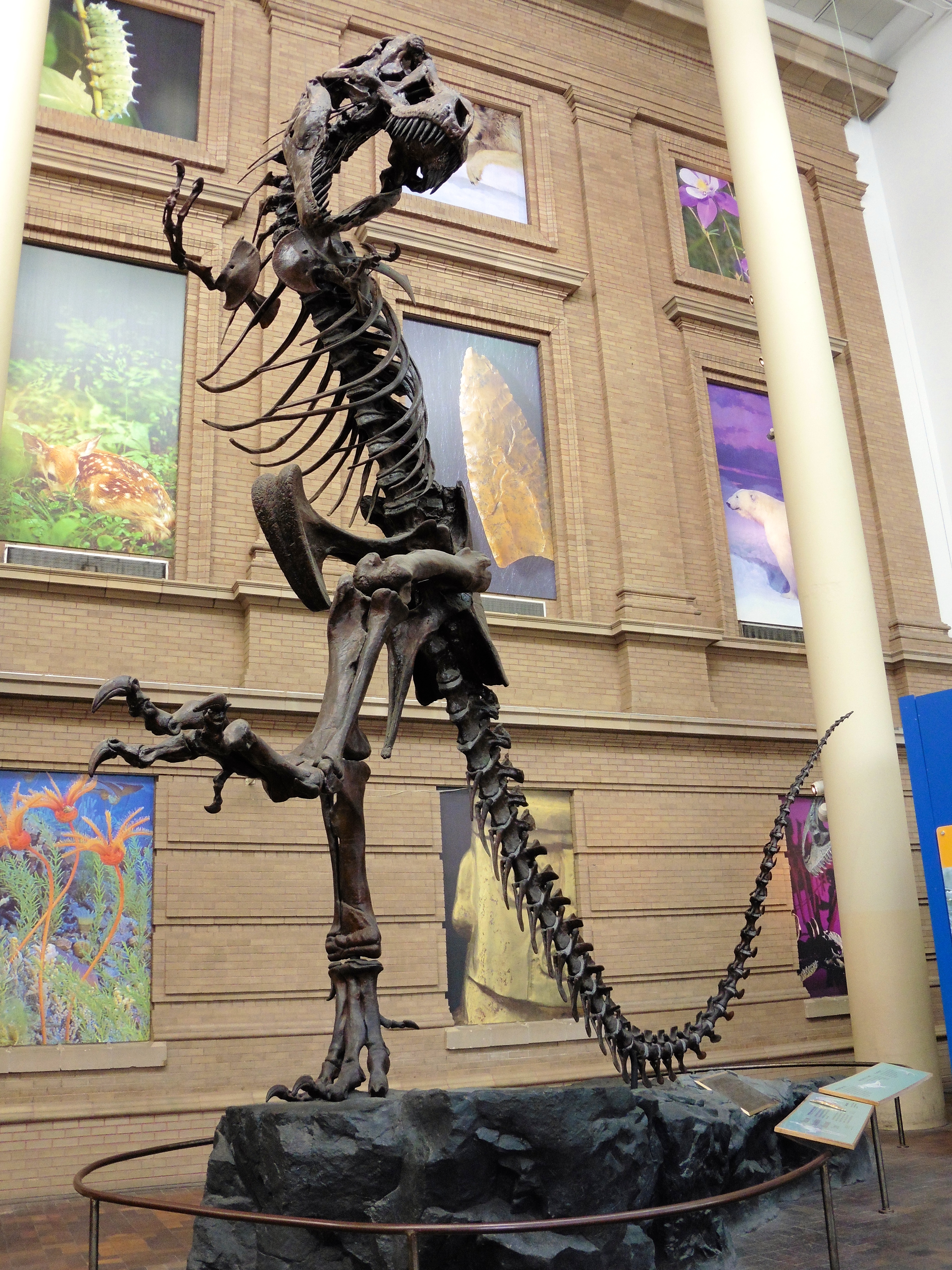
This piece provides the stunning backdrop to a mounted Albertosaurusskeleton in a similar pose. I must be honest – my access to the internet is very limited at the moment, so I've had trouble determining how old this painting (and the mount) are. I'd guess 1980s, but if any readers are able to fill me in, please do so. In any case, the star tyrannosaur is restored with a 'modern' posture and, unlike many Dino Renaissance-era pieces, isn't unduly skinny (although the legs look a little puny). Quite apart from the wonderful painterly backdrop (the sky alone is quite lovely), I really like the speculative dewlap/gular pouch on the Albertosaurus, which gives its neck an intriguingly different profile to that usually seen. Period curiosities include the reversed hallux on a tyrannosaur (which seemed to pop up quite a lot back in the '70s-'80s) and the bizarre-looking wisp of a pterosaur in the top right. No matter – it's still an awesome work.
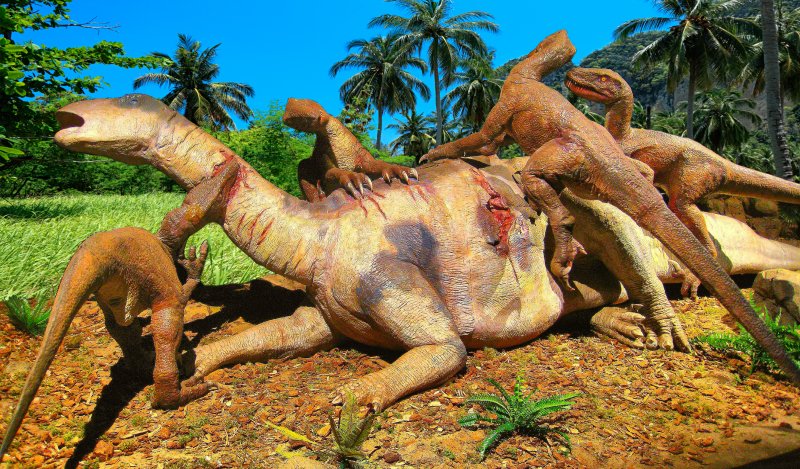
Appearing alongside the Albertosaurus in the book is this detail of two dromaeosaurs (adult and juvenile) scavenging a centrosaur carcass. It's presumably from the same panorama as the above, but, again, it's tricky for me to check just now. For obvious reasons pertaining to the Feathery Future, it hasn't aged too well; there's also the matter of the eyeball being in the wrong place, which gives these fellas a peculiarly lizardy look. There's something of the Bakkerian Deinonychus about these two, as well – it's probably the dewlap. Regardless, these are, again, beautifully painted, with superb patterning and an intriguing otherworldly quality about them.
Also from the Royal Tyrrell is this painting of nesting hadrosaurs, although unfortunately no artist is credited. The animals, which look well-proportioned if a little lean (typical of the era, really), are described in the book as 'Maiasaura', although I rather fancy that this is because Benton wanted to squeeze in a mention of the Good Mother Reptile – those head crests suggest a lambeosaurine. Nice work on the reflections in the puddles.
The work of a certain Greg Paul (for it is he) is featured here, too. His Avimimus (above) is notable for being remarkably prescient for 1993, a time when most artists were happy to copy Sibbick's Normanpedia version, which although feathered had a head straight out of the theropod spares bin. Of course, Paul did produce something similar himself, but the fact that he'd moved on to a small-headed, beaked restoration by 1993 just goes to show how he's often been ahead of the curve. The wattle on the neck is a great touch, too.
The two restorations underneath (skeletal & life) are just as remarkable, having been produced by Sergei Kurzanov, who described Avimumus in 1981. Kurzanov saw Avimimus as being even more birdlike than is now believed, and restored it as such, going so far as giving the animal hands like a modern bird and an extremely short tail. Of course, given how much feathers can obscure an animal's anatomy, it may well be that his life restoration isn't toofar off the mark after all.
Back to Paul, and here we have a seldom-seen restoration of Megalosaurus, the first dinosaur to get a (really unimaginative) name. [Gag about Owen removed from here because Buckland named it...not Owen. Not sure what I was thinking. Wasn't even drunk. Thanks Dave.] We're in 'generic big theropod' territory here, which isn't Paul's fault, of course, and the artist livens things up with some natty stripiness and moody driving rain. Inclement weather isn't seen often enough in palaeoart. The curled-up pronated forearms are a Predatory Dinosaurs of the World-era Paul staple that the artist himself has since abandoned in the light of anatomical evidence, but which have proven difficult to kill off in palaeoart more broadly (much to the chagrin of hundreds of internet pedants - especially me).
Paul also provides illustrations of a couple of dramatic confrontations between predator and prey. Here, the pin-headed sauropodomorph Massospondylusrears up to defend itself from Probably Coelophysis (aka Syntarsus, aka Megapnosaurus). I love the way the wispy clouds enhance the movement and drama here. The animals seem alarmingly thin even by Paulian standards, which suggests to me that this is an earlier piece by him. Close inspection reveals a crest of feather-like structures on the theropods (shades of Bakker) and those neck wattles again.
This illustration, depicting the tyrannosaur Tarbosaurus confronting the super-weirdo maniraptor Therizinosaurus, also appeared more recently in Paul's 2010 opus The (Princeton) Field Guide to Dinosaurs. Unusually, it was completely unaltered for The Field Guide in spite of Paul's (commendably brave) tendency to update his work according to advances in dinosaur science. You wouldn't get away with scaly therizinosaurs these days, chuck. Of course, for its day this is pretty damn remarkable – subtract the hadrosaur-like crest, add some floof, and you're more-or-less up to 2016 standards. Miles better than a quadrupedal 'prosauropod' version, or just drawing a giant pair of arms surrounded by an army of floating question marks.
And finally...have a couple of bonus vintage photographs of the London Natural History Museum's dinosaur gallery as it was, back in the day (by which I mean, long before I was born). Being a little lazy (and without home internet at the moment), I put the question of the above photo's date to my friends on Facebook, who promptly established it as late '60s – early '70s, prior to Dippy and, er, Trikey's removal to the Main Hall (shan't use that new name). The Triceratops was of course then moved again to the current dinosaur gallery, along with the Iguanodon also shown here, although (unlike Dippy) they retain their original tail-dragging poses. But I digress. Look at how light and airy it was! Can't we have a little natural light shining in on the gallery again NHM, pretty please?
The book also features a photograph of this intriguing thing, being half a Tyrannosaurus rex composed of bits of some of the earliest T. rex specimens found, along with material cast from other, more complete specimens and a few sculpted parts. Happily, Darren Naish once wrote at length on this unusual mount during the days of Tet Zoo Mk2. The lower jaw (part original, part sculpt), having been in storage for years, can now be seen again as one approaches the robotic T. rex in the current gallery, while the skull was unearthed some years back and put on display as part of a temporary exhibition featuring a panoply of robosaurs. Presumably, the rest of this beast is buried somewhere deep within the NHM's mahoosive store rooms, being looked after by top. Men. It's a shame that it can no longer be seen, but at least the NHM now has a mount of a British dinosaur – Baryonyx– in the same spirit.
For my next post: I went to Dorset, and I found a Dinosauroid there.
Being fit and healthy is important for a long and happy life! Get latest news, videos and photos on health, physical fitness, body fitness, fitness tips, fitness band.
Showing posts with label '90s. Show all posts
Vintage Dinosaur Art: Dinosaurs - Living Monsters of the Past (Part 1)
Here's a book that I bought some months ago, only for it to disappear under a pile of quirkier, more remarkable tomes acquired from eBay. It's very typical early '90s fare (1993 specifically), authored by palaeontologist Michael Benton (who writes a popular book on dinosaurs aimed at a young audience every morning over breakfast) and illustrated by a number of artists, but mostly John Sibbick. However (and quite apart from the fantastic cover), I may have unfairly overlooked it. The Sibbick pieces on their own are worthy of a VDA post, and it's exactly those that I'll be looking at here.
...Which doesn't include the cover, I'm afraid. It's a lovely piece though, painted by Vladimir Krb to accompany an Albertosaurus skeletal mount at the Royal Tyrrell Museum of Palaeontology in Alberta, Canada. It's here because I gots to include the cover, but I'll discuss it more next time. For now, there's Sibbick to be had.
The book is a fairly straightforward tour through the Mesozoic from start to finish, looking at which dinosaurs lived when, and also going into detail about the history behind some key palaeontological discoveries. Naturally, Plateosaurus pops up right at the start as an example of an Early Large Dinosaur. This reconstruction by Sibbick actually holds up better than many more recent ones, mainly because although the animals are depicted on all fours, they aren't moving anywhere in a hurry. (Or galloping.) Of course, many other aspects of the restoration are dated (the lack of meat at the base of the tail, for example), but for the early '90s it's not bad.
Although equally monochrome, Sibbick's Coelophysis is far more striking than his plateosaurs, decked out as it is in dashing spots-'n'-stripes. When compared with the Normanpedia Coelophysis (which was still being widely copied by other artists at the time), this is an altogether sleeker, more birdlike and less awkward-looking beast, and the fine details still impress; note the convincing flexion of the feet and toes as the animal strides forwards. Lovely vegetation, too.
In addition to the 'feature dinos', Sibbick also illustrated collections of closely-related animals. In this case, it's Now That's What I Call Stegosaurs, with the eponymous beastie standing proudly at the top. Moving clockwise around, we then have Tuojiangosaurus, Kentrosaurus, Lexovisaurus (middle) and Dacentrurus. For the most part these are rather nicely done - the Stegosaurus is reminiscent of the beautiful model made by Stephen Czerkas, only with a different plate arrangement. All of them have a very 'modern' look, with erect necks, tails and limbs. Only the Kentrosaurus seems a bit of a cop out - it's comparatively shapeless and non-descript, its legs hidden by generic-o-shrubs as if Sibbick couldn't be arsed finishing them. And the shoulder (or should that be hip?) spikes are missing. [EDIT: It may be that the caption in my copy has Dacentrurus and Kentrosaurus reversed - thanks to Vladimir Nikolov for pointing this out over on Facebook.] Still, lovely stuff overall.
Giant sauropods - now we're talking. Unlike those in some of Sibbick's '80s work, these are very much sauropods in the post-Dino Renaissance mould, tails held proudly aloft, striding purposefully forward and not taking no nonsense from nobody. Somehow, Sibbick pulls off the feat of making them look massive without much in the way of a point of reference (save the trees in the background); there's a firm impression of all that fleshy tonnage (and accurate feet to boot). That'll be Supersaurus (with snazzy stripes) at the back, perhaps slightly oversized in relation to Brachiosaurus, which here takes the middle ground. On the left we have...Brachiosaurus again. Sort of. As you've probably guessed, it's actually intended to represent the chimeratastic 'Ultrasauros', that long-forgotten mainstay of '90s dinosaur books - composed, fittingly enough, of parts from Brachiosaurus and Supersaurus.
Predictably, the book's theropods are far more dated than the sauropods, mainly thanks to all those pesky fluffy things that people keep turning up. Still, for the early '90s these dromaeosaurs (and extra) are all right - well proportioned and convincingly less lizardy-looking than the Normanpedia versions. The largest dromaeosaur is Deinonychus, of course, depicted with a retro-style allosauresque muzzle, while Dromaeosaurus and Velociraptor take the rear and front, respectively. Velociraptor's skull is especially well observered, as is that of Baryonyx. Which begs the question: what is Baryonyx doing here? Well, the title of the spread in which this illustration features is 'The Sickle Claws', and Benton notes in the text that
And speaking of giant hadrosaurs (seamless, I know)...here they are! Mostly in the form of cool haids. As usual, this lot appear to be modelling for a salon crest product catalogue; the crestless ones are Hadrosaurus (top) and Edmontosaurus (bottom), and you know the rest. Some lovely patterning again here, especially on Saurolophus' disembodied head, while poor old Tsintaosaurus' phallic appendage has never looked so upsettingly veiny. Noteworthy is the very Paulian appearance of the full-bodied hadrosaurs, now clearly depicted as being primarily quadrupedal. They're very well done for the time.
The other classical herbivores of the Cretaceous, the ceratopsians (titanosaurs? Who they?), are resplendent in all their monochromatic Sibbickian glory. They may look a little '90s-skinny these days (only Triceratops seems convincingly bulky), but these are still excellent illustrations. The Styracosaurus, with its slightly haggard, angular appearance and staring, beady eye is my favourite. It's just a shame that Sibbick didn't see fit to adorn these beasts with the same sort of beautiful patterning as seen elsewhere in the book - those frills are asking for it.
And finally...tyrannosaurs. It's normally quite easy to guess who's who, but some odd decisions have been made here that make it unclear. According to the caption, we have (from left to right) Daspletosaurus, Tyrannosaurus and Tarbosaurus. Whereas Daspletosaurus' head is alarmingly shrink-wrapped, the noggin on Rexy doesn't seem to fit a real T. rex skull very well at all, instead resembling that of a sort of generic giant carnivorous dinosaur. The arms are also far too long in the case of Tyrannosaurus and Tarbosaurus, and while this was very common at the time, it's especially jarring on the latter, which had stupid tiddly arms even for a tyrannosaur. I do like the perspective on the Tarbosaurus (unusual and effective), and Sibbick's produced plenty of brilliant tyrannosaur illustrations since, but it's a shame that Rexy couldn't have been more Sexy in this case.
Next time: more from Living Monsters, including Greg Paul (for it is he) and half a Tyrannosaurus. Right after I move house.
...Which doesn't include the cover, I'm afraid. It's a lovely piece though, painted by Vladimir Krb to accompany an Albertosaurus skeletal mount at the Royal Tyrrell Museum of Palaeontology in Alberta, Canada. It's here because I gots to include the cover, but I'll discuss it more next time. For now, there's Sibbick to be had.
The book is a fairly straightforward tour through the Mesozoic from start to finish, looking at which dinosaurs lived when, and also going into detail about the history behind some key palaeontological discoveries. Naturally, Plateosaurus pops up right at the start as an example of an Early Large Dinosaur. This reconstruction by Sibbick actually holds up better than many more recent ones, mainly because although the animals are depicted on all fours, they aren't moving anywhere in a hurry. (Or galloping.) Of course, many other aspects of the restoration are dated (the lack of meat at the base of the tail, for example), but for the early '90s it's not bad.
Although equally monochrome, Sibbick's Coelophysis is far more striking than his plateosaurs, decked out as it is in dashing spots-'n'-stripes. When compared with the Normanpedia Coelophysis (which was still being widely copied by other artists at the time), this is an altogether sleeker, more birdlike and less awkward-looking beast, and the fine details still impress; note the convincing flexion of the feet and toes as the animal strides forwards. Lovely vegetation, too.
In addition to the 'feature dinos', Sibbick also illustrated collections of closely-related animals. In this case, it's Now That's What I Call Stegosaurs, with the eponymous beastie standing proudly at the top. Moving clockwise around, we then have Tuojiangosaurus, Kentrosaurus, Lexovisaurus (middle) and Dacentrurus. For the most part these are rather nicely done - the Stegosaurus is reminiscent of the beautiful model made by Stephen Czerkas, only with a different plate arrangement. All of them have a very 'modern' look, with erect necks, tails and limbs. Only the Kentrosaurus seems a bit of a cop out - it's comparatively shapeless and non-descript, its legs hidden by generic-o-shrubs as if Sibbick couldn't be arsed finishing them. And the shoulder (or should that be hip?) spikes are missing. [EDIT: It may be that the caption in my copy has Dacentrurus and Kentrosaurus reversed - thanks to Vladimir Nikolov for pointing this out over on Facebook.] Still, lovely stuff overall.
Giant sauropods - now we're talking. Unlike those in some of Sibbick's '80s work, these are very much sauropods in the post-Dino Renaissance mould, tails held proudly aloft, striding purposefully forward and not taking no nonsense from nobody. Somehow, Sibbick pulls off the feat of making them look massive without much in the way of a point of reference (save the trees in the background); there's a firm impression of all that fleshy tonnage (and accurate feet to boot). That'll be Supersaurus (with snazzy stripes) at the back, perhaps slightly oversized in relation to Brachiosaurus, which here takes the middle ground. On the left we have...Brachiosaurus again. Sort of. As you've probably guessed, it's actually intended to represent the chimeratastic 'Ultrasauros', that long-forgotten mainstay of '90s dinosaur books - composed, fittingly enough, of parts from Brachiosaurus and Supersaurus.
Predictably, the book's theropods are far more dated than the sauropods, mainly thanks to all those pesky fluffy things that people keep turning up. Still, for the early '90s these dromaeosaurs (and extra) are all right - well proportioned and convincingly less lizardy-looking than the Normanpedia versions. The largest dromaeosaur is Deinonychus, of course, depicted with a retro-style allosauresque muzzle, while Dromaeosaurus and Velociraptor take the rear and front, respectively. Velociraptor's skull is especially well observered, as is that of Baryonyx. Which begs the question: what is Baryonyx doing here? Well, the title of the spread in which this illustration features is 'The Sickle Claws', and Benton notes in the text that
"It is still not clear whether Baryonyx is a deinonychid or not, and indeed it is not certain whether the claw went on its hand or foot!"Which is curious, as I thought that everyone was quite certain by '93 that the heavy claws went on the hands, though my memories of the time largely consist of me watching a certain movie and then playing with my Command Compound Playset. Regardless, Sibbick's illustration depicts Baryonyx in its typical role of specialised fish eater, which is fine, but I do like that Dromaeosaurus is shown making off with a small lizard-like animal (as opposed to leaping at a giant hadrosaur much larger than itself, or something equally daft).
And speaking of giant hadrosaurs (seamless, I know)...here they are! Mostly in the form of cool haids. As usual, this lot appear to be modelling for a salon crest product catalogue; the crestless ones are Hadrosaurus (top) and Edmontosaurus (bottom), and you know the rest. Some lovely patterning again here, especially on Saurolophus' disembodied head, while poor old Tsintaosaurus' phallic appendage has never looked so upsettingly veiny. Noteworthy is the very Paulian appearance of the full-bodied hadrosaurs, now clearly depicted as being primarily quadrupedal. They're very well done for the time.
The other classical herbivores of the Cretaceous, the ceratopsians (titanosaurs? Who they?), are resplendent in all their monochromatic Sibbickian glory. They may look a little '90s-skinny these days (only Triceratops seems convincingly bulky), but these are still excellent illustrations. The Styracosaurus, with its slightly haggard, angular appearance and staring, beady eye is my favourite. It's just a shame that Sibbick didn't see fit to adorn these beasts with the same sort of beautiful patterning as seen elsewhere in the book - those frills are asking for it.
And finally...tyrannosaurs. It's normally quite easy to guess who's who, but some odd decisions have been made here that make it unclear. According to the caption, we have (from left to right) Daspletosaurus, Tyrannosaurus and Tarbosaurus. Whereas Daspletosaurus' head is alarmingly shrink-wrapped, the noggin on Rexy doesn't seem to fit a real T. rex skull very well at all, instead resembling that of a sort of generic giant carnivorous dinosaur. The arms are also far too long in the case of Tyrannosaurus and Tarbosaurus, and while this was very common at the time, it's especially jarring on the latter, which had stupid tiddly arms even for a tyrannosaur. I do like the perspective on the Tarbosaurus (unusual and effective), and Sibbick's produced plenty of brilliant tyrannosaur illustrations since, but it's a shame that Rexy couldn't have been more Sexy in this case.
Next time: more from Living Monsters, including Greg Paul (for it is he) and half a Tyrannosaurus. Right after I move house.
Vintage Dinosaur Art: Dinosaurs, National Geographic, January 1993
The last time I looked at an old issue of National Geographic, it was from 1978, when the ideas put forward in the Dinosaur Renaissance were starting to take hold in the popular imagination. Fifteen years later, and Vol. 183, No. 1 shows just how much progress had been made. What's especially fascinating about this issue of Nat Geo is that it not only looks at the current state of the science, but also how dinosaurs were enjoying a resurgence in popularity among the general public at the time, in turn offering an insight into contemporary trends in palaeoart. Which means John Gurche. Lots of John Gurche.
Although not the only artist to partake in this Dinosaur Special (more on the others next time), Gurche's stupefyingly detailed paintings accompany the main magazine article, and his nesting Saurolophus stares out from the cover. From a technical standpoint, Gurche's work often remains mind-boggling - his paintings frequently resemble elaborately staged photographs of scale models, such is his mastery of light and shadow. Of course, his dinosaurs are also very much products of their time, just as much as anything from 1978. The Saurolophus remains gorgeously painted, but is quite hideously shrink-wrapped by modern standards - particularly around its face, which would give Rameses II a run for his money in the spine-chilling dessication stakes.
Gurche's typical aesthetic is very well known among dinosaur art enthusiasts, and he seems to have a tendency to paint hyper-detailed brown wrinkly things in dustbowl environments, such as these pachycephalosaurs. It's obvious that the 'Gurche look' was virtually lifted wholesale for many of Jurassic Park's creatures, especially the brachiosaur; his website states that he worked on the movie, in a role that other online sources describe as 'consultant'. (Unfortunately, the Jurassic franchise's unwarranted conservatism led to '90s-era Gurche-o-saurs hitting the big screen again last year, but Gurche can hardly be blamed for that. And I digress.) All these years later, this work still looks extremely convincing, even if a great many of the animals portrayed probably didn't have quite such elephantine, leathery skin.
While the pachycephalosaur painting might be the most stereotypically Gurchesque among those featured here, the aforementioned Saurolophus scene does also feature rather uniformly brown creatures in a largely arid environment, albeit with some absolutely spectacular lighting going on back there. But that's far from all he can do.
In the above scene, we are invited to adopt the perspective of a clutch of small cynodonts as they scarper to avoid the gaze of Herrerasaurus. From their point of view, this relatively small dinosaur - shorter than an adult human - becomes an enormous, looming, and terrifying threat. It's fantastically effective. Here, the dinosaur enjoys its (literal) day in the sun, bathed in light, while the proto-mammals are reduced to cowering in the shadows.
The article covers the usual narrative of the dinosaurs' rise, fall, and rediscovery ("I am Ozymandosaurus," and all that), while also shedding light on remarkable recent discoveries, many of which have overturned old notions about what dinosaurs were like. As such, Gurche here illustrates an Arctic scene from the Late Cretaceous - juvenile edmontosaurs are stalked from the trees by a fascinatingly sinister tyrannosaur. The crisp wrinkles on the hadrosaurs are none-more-'90s, but for my money the tyrannosaur remains a wonderful piece of work. It can be difficult to imagine how such large animals were able to conceal themselves from their prey, but Gurche brings the scenario to life in an utterly believable way through a superb use of perspective, shadow, and cryptic camouflage on the creature. Aspiring palaeoartists may also like to note how having a predator calmly contemplating its strike is actually far more exciting (not to mention realistic) than having it roaring and slobbering like an idiot. Less is more, and all that. (Oh, and beautiful backdrop, too.)
Something more on that 'pop culture resurgence', now. The article features a glimpse into the workshop of Kokoro, a Japanese manufacturer of robo-saurians. And bloody hell but if they aren't quite uncommonly beautiful to look at. Why can't we have more exhibits with robots like these? I mean, apart from the fact that I'd go broke. The Deinonychus gang resemble those that, sadly, still hang around the NHM (London)'s dinosaur gallery in an increasingly dilapidated state; I can only imagine that Kokoro supplied them back in the day. Incidentally, Kokoro are still going, and now have an operation in America - unfortunately, it would appear that the Deinonychus gang is still going, too.
There's no word on who made this model, but never mind - that's an awesome photo. Shot 'somewhere near Alburquerque', apparently, a city that I still can't envisage as being a real place that exists outside of Looney Tunes. The model being transported here has actually aged rather well, too, mostly thanks to its correct forelimb orientation. It also reminded me of a dinosaur park I'd heard about over in the States, which reminded me that it's in trouble (red tape, it would seem) - it's a shame, as it's reliant entirely on donations, has increasingly well-researched models, and has clearly brought a lot of joy to local kids. Go and buy owner Chris a beer, why not.
And finally...it wouldn't be a '90s article about dinosaurs without that photo of Bob Bakker posing next to that Tyrannosaurus mount (in Denver). Which looks really cool from this angle, but a little silly from others. Hello ma baby, hello ma honey...
Although not the only artist to partake in this Dinosaur Special (more on the others next time), Gurche's stupefyingly detailed paintings accompany the main magazine article, and his nesting Saurolophus stares out from the cover. From a technical standpoint, Gurche's work often remains mind-boggling - his paintings frequently resemble elaborately staged photographs of scale models, such is his mastery of light and shadow. Of course, his dinosaurs are also very much products of their time, just as much as anything from 1978. The Saurolophus remains gorgeously painted, but is quite hideously shrink-wrapped by modern standards - particularly around its face, which would give Rameses II a run for his money in the spine-chilling dessication stakes.
Gurche's typical aesthetic is very well known among dinosaur art enthusiasts, and he seems to have a tendency to paint hyper-detailed brown wrinkly things in dustbowl environments, such as these pachycephalosaurs. It's obvious that the 'Gurche look' was virtually lifted wholesale for many of Jurassic Park's creatures, especially the brachiosaur; his website states that he worked on the movie, in a role that other online sources describe as 'consultant'. (Unfortunately, the Jurassic franchise's unwarranted conservatism led to '90s-era Gurche-o-saurs hitting the big screen again last year, but Gurche can hardly be blamed for that. And I digress.) All these years later, this work still looks extremely convincing, even if a great many of the animals portrayed probably didn't have quite such elephantine, leathery skin.
While the pachycephalosaur painting might be the most stereotypically Gurchesque among those featured here, the aforementioned Saurolophus scene does also feature rather uniformly brown creatures in a largely arid environment, albeit with some absolutely spectacular lighting going on back there. But that's far from all he can do.
In the above scene, we are invited to adopt the perspective of a clutch of small cynodonts as they scarper to avoid the gaze of Herrerasaurus. From their point of view, this relatively small dinosaur - shorter than an adult human - becomes an enormous, looming, and terrifying threat. It's fantastically effective. Here, the dinosaur enjoys its (literal) day in the sun, bathed in light, while the proto-mammals are reduced to cowering in the shadows.
The article covers the usual narrative of the dinosaurs' rise, fall, and rediscovery ("I am Ozymandosaurus," and all that), while also shedding light on remarkable recent discoveries, many of which have overturned old notions about what dinosaurs were like. As such, Gurche here illustrates an Arctic scene from the Late Cretaceous - juvenile edmontosaurs are stalked from the trees by a fascinatingly sinister tyrannosaur. The crisp wrinkles on the hadrosaurs are none-more-'90s, but for my money the tyrannosaur remains a wonderful piece of work. It can be difficult to imagine how such large animals were able to conceal themselves from their prey, but Gurche brings the scenario to life in an utterly believable way through a superb use of perspective, shadow, and cryptic camouflage on the creature. Aspiring palaeoartists may also like to note how having a predator calmly contemplating its strike is actually far more exciting (not to mention realistic) than having it roaring and slobbering like an idiot. Less is more, and all that. (Oh, and beautiful backdrop, too.)
Something more on that 'pop culture resurgence', now. The article features a glimpse into the workshop of Kokoro, a Japanese manufacturer of robo-saurians. And bloody hell but if they aren't quite uncommonly beautiful to look at. Why can't we have more exhibits with robots like these? I mean, apart from the fact that I'd go broke. The Deinonychus gang resemble those that, sadly, still hang around the NHM (London)'s dinosaur gallery in an increasingly dilapidated state; I can only imagine that Kokoro supplied them back in the day. Incidentally, Kokoro are still going, and now have an operation in America - unfortunately, it would appear that the Deinonychus gang is still going, too.
There's no word on who made this model, but never mind - that's an awesome photo. Shot 'somewhere near Alburquerque', apparently, a city that I still can't envisage as being a real place that exists outside of Looney Tunes. The model being transported here has actually aged rather well, too, mostly thanks to its correct forelimb orientation. It also reminded me of a dinosaur park I'd heard about over in the States, which reminded me that it's in trouble (red tape, it would seem) - it's a shame, as it's reliant entirely on donations, has increasingly well-researched models, and has clearly brought a lot of joy to local kids. Go and buy owner Chris a beer, why not.
And finally...it wouldn't be a '90s article about dinosaurs without that photo of Bob Bakker posing next to that Tyrannosaurus mount (in Denver). Which looks really cool from this angle, but a little silly from others. Hello ma baby, hello ma honey...
Subscribe to:
Posts (Atom)