Showing posts with label National Geographic. Show all posts

Vintage Dinosaur Art: Dinosaurs (Books for Young Explorers)

Once again, Charles Leon has sent me a real peach. Dinosaurs (part of the National Geographic Society's Books for Young Explorers series) was published in 1972 and features artwork by Jay H Matternes, with text from Kathryn Jackson. Matternes was an accomplished palaeoartist, but given that his speciality and main area of interest was apparently fossil primates (particularly hominids), his name will be unfamiliar to many dinosaur enthusiasts (it certainly was to me). In spite of this, his work here is beautifully painted and easily a match for near enough anything else around at the time.

According to his website, Matternes worked with a great number of illustrious clients, from Nat Geo to Time to all manner of natural history museums. Based on his talents here alone, it's easy to see why. The illustrations here are all very retro now, of course, and typically early '70s in many respects - in the underdeveloped musculature of the dinosaurs, their often tail-dragging postures, and so on. However, it's the appreciation of fine detail, the often surprising dynamism of the pieces, and the entirely naturalistic feel of the animals that let us know there's an accomplished artist at work.


But before we get to all that, let's just take a moment to appreciate these excellent 1970s fashions. Rockin' those stripy trousers there, kids.


Our story begins, as it is wont to do, in the Triassic. A herd of Placerias-like beasties are hanging around a swamp, trying to avoid the attentions of a big-headed smiley fellow. At the lower edge of this scene - leading us off over the next page and on to the Mesozoic adventures to follow - are a pair of generic 'thecodonts' (possibly based on Lagosuchus or Euparkeria). Tellingly, the thecodonts seem to have had the most detail lavished upon them; they feel better textured and more solidly three-dimensional than the other animals in the scene. Which isn't to say that the whole thing isn't beautifully painted, not to mention remarkably peaceful-feeling. That can't last.


No sooner have the 'thecodonts' had a chance to evolve into true dinosaurs, than they are snapped up by some prowling phytosaur by the water's edge. (Of course, these days Saltopus is thought to have been a dinosauriform rather than a 'true' dinosaur. Sucks for Saltopus.) I would mention that the attention to detail on the phytosaur here (crater nostrils!) is commendable, but I'm being far too distracted by the water. That water's gorgeous. I might even be tempted to go for a swim if it wasn't quite so rust-coloured.


Now we're into more solidly dinosaurian territory (except for Teratosaurus).The plateosaurs are fine and dandy for the time, but I love the angry Coelophysis in the lower right. Crouched down, tail whipping in the air, mouth wide open, it's spoiling for a fight.


Perhaps my least favourite piece is this one featuring a merry band of very Knightian brontosaurs, trudging boringly off into the water to escape Allosaurus' clutches. At first glance, there isn't a lot that elevates this above a typical Knight/Burian clone, but the fantastic work done on the sky and water in particular does demonstrate a superior artist at work. Hey, dinosaurs weren't his speciality.


And now we come to the main reason I opted to write a post about this book rather than one of the many others Charles has sent me recently - a brachiosaur with a rainbow. Well, almost a rainbow. Again, at first glance, one might be tempted to write this off as another Burian knock-off (even if the brachiosaur is happily standing on dry land). However, note all the small things - the carefully shaded muscle tone, the intricately detailed head, and the single claw on each hand. And again, the sky. I love a good sky.


On to the Late Cretaceous, and the skies aren't as spectacular, but the above piece is one of my absolute favourites. It's just plain gorgeous to look at - the animals' skin textures are handled beautifully, with any number of lifelike folds, wrinkles and bony nodules, and for the time they are superb from an anatomical standpoint. I mean, Styracosaurus actually appears to have a neck and defined muscles, rather than simply being a large tube attached to four smaller, stubbier tubes. The background details are especially superb in this one - the trees are beautiful, of course, but notice also small details such as the tiny mammals directly below the Styracosaurus. Lovely.


And so to Rexy. The head may look a little strange, but this is a very forward-thinking restoration for the early 1970s, and well-researched with it. Note in particular the appropriately tiny arms (by no means a given even now), firmly horizontal posture and birdlike feet. While the muscles are rather weedy (typical of pre-Dino Renaissance thinking), this is a portrait of an alert, active predator.

Ankylosaurus, meanwhile, is also quite typical in being a "Palaeoscincus"-style mish-mash of nodosaurid and ankylosaurid features (the shoulder spikes are very Edmontonia). In spite of this, this is another very good restoration from a time when ankylosaurs tended to be depicted as short-tailed grumpy pineapples with four feet, but no legs.


Unfortunately, the book's hadrosaurs are still web-footed water-dwellers feeding on soft 'n' mushy material, but at least they're well painted; the wonderful pebbly skin texture on the foreground individual reminds me of Bernard Robinson's work, only with rather more anatomical accuracy. In spite of being so ostensibly trope-tastic (angry geography, aquatic hadrosaurs, Pteranodon overhead etc. etc.) this is still a very convincing-looking scene. Just don't mention the fact that the animals depicted here predated T. rex by millions of years (although to be fair, Rexy isn't actually in the painting).

"STRONG AND STABLE LEADERSHIP!"
Monoclonius didn't live alongside Rexy either, but it hasn't stopped the two animals sparring over the years in palaeoart (and short films). Here, Rexy attempts to intimidate the ceratopsians with his birdlike strut and gaping maw, but they're having none of it. The flatter-than-Flevoland landscapes do get a bit tedious, but you've got to admire any work from 1972 that features a T. rex that almost looks like it was painted a good 20 years later.

Since the centrosaurs aren't budging, Rexy decides to tackle something twice as large and with a bad temper. As you do.


Yes, it's the front cover again. This painting doesn't quite feel of a piece with the others; the style seems to have changed, and the depiction of T. rex, formerly consistent, suddenly sports obvious differences (it's not even the same colour). It's gorgeously painted, but feels more 'retro' than the rest of the book. I'd hazard a guess that it was painted some years beforehand, and recycled here. It feels more like a standalone piece, with finer detail throughout, than the others (not to mention the fact that it seems weirdly familiar). If anyone has a clue, then let me know...


And finally...the endpapers, just as a reminder of what most other palaeoart was like at the time. Drag them tails, boys.

Vintage Dinosaur Art: Dinosaurs, National Geographic, January 1993 - Free poster bonus!

Those of you with a nostalgic fondness for the January '93 issue of National Geographic featured in the last post will likely recall the free poster to be found within. Happily, the copy of the magazine that I bought on eBay arrived complete with said freebie, in all of its glossy, double-sided 1990s glory. One side of the poster displays a map of North America in the Late Cretaceous, surrounded by groups of Late Cretaceous dinosaurs illustrated by John Sibbick; the other features 'Dawn on the Delta', a lovely panorama starring Anchiceratops and painted by Robert Giusti. Let's look at the Sibbick side first of all, and specifically this delightful group of hadrosaurs, because the whole thing won't fit in my scanner and my photographs of it are terrible.


Well, OK, it's actually 'hadrosaurs and pachycephalosaurs', thrown in at the back because they were bipedal herbivores or summink. Unfortunately, the foreground ornithopods easily steal Stigipachymolochosaurus' thunder, looking as handsome and colourful as they do. For the early '90s these really are marvellous, with hands made for walking (rather than dangling awkwardly) and a convincing heft. Lambeosaurus in particular looks resplendent in its lovely Sibbickian green camouflage livery, delivering a suitably disdainful look toward the viewer. In fact, all of the middle three look almost like they're posing moodily and pouting, like they're modelling for some sort of hadrosaur salon photo shoot. Glorious red balloon atop Saurolophus, too. (The slightly anachronistic groupings are deliberate, by the way, just as they were in the Normanpedia. So stop yer moaning.)


The hadrosaurs are very pretty on their own, but before we carry on I should probably give some indication of what the whole poster looks like. So here it is. As I said, I found it very difficult to photograph with my wee compact camera. Apologies. Hey, look over there, ceratopsians!


The behorned ones display a bow-armed posture now considered quite likely, although the show off on the right might just be squaring up against the viewer. The restorations are dated in some respects (the hands) and Triceratops' frill appears to have collapsed, but it's still top drawer Sibbick. The heads of the two centrosaurs are drawn from tricky angles with the utmost attention to detail. And look, there's a bonus '90s Troodon! Is it me, or does it suddenly feel chilly in here?


Time for TANKS. The perspective on Euoplocephalus is great, but Sibbick may well have underestimated just how extremely wide and flat-topped the beast was. Edmontonia is a little disappointingly brown, although admittedly the rather severe, unwieldy, unfriendly look of ankylosaurs doesn't lend itself well to colourful gaiety. Also, the TANKS we have today do tend to be brown. Or grey.


Of course, ankylosaurs evolved their strange looks and spikes as a defence against the bone-crushing mega-bites of the most awesomest of dinosaurs - the tyrannosaurs. Here, Daspletosaurus enjoys a dip as lanky Albertosaurus juveniles sprint by, whereas a slightly unbalanced looking Sexy Rexy just hangs around in the background, lest he make the rest look decidedly puny by comparison. Happily, Sibbick's habit of giving his large theropods a convincing sense of mass is very much evident here; there was a tendency at the time to draw these multi-tonne behemoths skipping around like little girls on the way back from school. The tagliatelle tails and Greg Paul-esque curled-up pronated forearms are dated now, but at least Rexy has nice short, stocky arms. Some people forgot that back in '93.


As a bonus, here are the various marine creatures hanging around above Rexy's head. Some of them haven't aged especially well - the Tylosaurus (with Chaz Knight crest!) appears particularly dated, and that Elasmosaurus looks rather...off to me, although you'd have to ask a marine reptile guy. Cool colours on the Xiphactinus, mind.


The other side of the poster is a very different affair, featuring as it does a single large, panoramic illustration, although there are still plenty of interesting beasties to look at, dinosaur or otherwise. The star is Anchiceratops, the chasmosaurine you always forget about in favour of one of the more famous ones. Elsewhere we have boring old Edmontosaurus, the stinkin' mammal Cimolestes, turtle Aspideretes, Quetzalcoatlus, a plesiosaur (just visible doing a Nessie behind the wallowing hadrosaur) and a cockroach, who wished to remain anonymous. It's a bustling scene with an admirable variety of flora and fauna, and even it it does look a little contrived it remains very informative.


The central Anchiceratops is depicted shielding a tiny baby, which is very cute with its stumpy horns and snub-nosed face and d'awww. Giusti's painting is certainly excellent, with the vegetation is especially well detailed. The dinosaurs' skin is very Sibbickian, and it seems Giusti drew quite a lot of inspiration from the Normanpedia...


...For lurking in the background are these oddly mismatched Anchiceratops, plainly modelled on different Normanpedia ceratopsians. Sibbick's Anchiceratops (fittingly enough) provided the head for the one on the left, while the individual furthest forward is clearly based on his Centrosaurus. The middle one likely draws on the NP Triceratops. Elsewhere, Sibbickian head-nubbined Quetzalcatlus fly overhead. In the end, although Sibbick only illustrated one side of this poster, his all-conquering influence pervades the other side, too! Still, it's a pleasing piece from Giusti. I'd hang it on me wall.

Coming up next time: I'm moving home soon, so it might be a while! Do bear with me.

Vintage Dinosaur Art: Dinosaurs, National Geographic, January 1993

The last time I looked at an old issue of National Geographic, it was from 1978, when the ideas put forward in the Dinosaur Renaissance were starting to take hold in the popular imagination. Fifteen years later, and Vol. 183, No. 1 shows just how much progress had been made. What's especially fascinating about this issue of Nat Geo is that it not only looks at the current state of the science, but also how dinosaurs were enjoying a resurgence in popularity among the general public at the time, in turn offering an insight into contemporary trends in palaeoart. Which means John Gurche. Lots of John Gurche.


Although not the only artist to partake in this Dinosaur Special (more on the others next time), Gurche's stupefyingly detailed paintings accompany the main magazine article, and his nesting Saurolophus stares out from the cover. From a technical standpoint, Gurche's work often remains mind-boggling - his paintings frequently resemble elaborately staged photographs of scale models, such is his mastery of light and shadow. Of course, his dinosaurs are also very much products of their time, just as much as anything from 1978. The Saurolophus remains gorgeously painted, but is quite hideously shrink-wrapped by modern standards - particularly around its face, which would give Rameses II a run for his money in the spine-chilling dessication stakes.


Gurche's typical aesthetic is very well known among dinosaur art enthusiasts, and he seems to have a tendency to paint hyper-detailed brown wrinkly things in dustbowl environments, such as these pachycephalosaurs. It's obvious that the 'Gurche look' was virtually lifted wholesale for many of Jurassic Park's creatures, especially the brachiosaur; his website states that he worked on the movie, in a role that other online sources describe as 'consultant'. (Unfortunately, the Jurassic franchise's unwarranted conservatism led to '90s-era Gurche-o-saurs hitting the big screen again last year, but Gurche can hardly be blamed for that. And I digress.) All these years later, this work still looks extremely convincing, even if a great many of the animals portrayed probably didn't have quite such elephantine, leathery skin.


While the pachycephalosaur painting might be the most stereotypically Gurchesque among those featured here, the aforementioned Saurolophus scene does also feature rather uniformly brown creatures in a largely arid environment, albeit with some absolutely spectacular lighting going on back there. But that's far from all he can do.


In the above scene, we are invited to adopt the perspective of a clutch of small cynodonts as they scarper to avoid the gaze of Herrerasaurus. From their point of view, this relatively small dinosaur - shorter than an adult human - becomes an enormous, looming, and terrifying threat. It's fantastically effective. Here, the dinosaur enjoys its (literal) day in the sun, bathed in light, while the proto-mammals are reduced to cowering in the shadows.


The article covers the usual narrative of the dinosaurs' rise, fall, and rediscovery ("I am Ozymandosaurus," and all that), while also shedding light on remarkable recent discoveries, many of which have overturned old notions about what dinosaurs were like. As such, Gurche here illustrates an Arctic scene from the Late Cretaceous - juvenile edmontosaurs are stalked from the trees by a fascinatingly sinister tyrannosaur. The crisp wrinkles on the hadrosaurs are none-more-'90s, but for my money the tyrannosaur remains a wonderful piece of work. It can be difficult to imagine how such large animals were able to conceal themselves from their prey, but Gurche brings the scenario to life in an utterly believable way through a superb use of perspective, shadow, and cryptic camouflage on the creature. Aspiring palaeoartists may also like to note how having a predator calmly contemplating its strike is actually far more exciting (not to mention realistic) than having it roaring and slobbering like an idiot. Less is more, and all that. (Oh, and beautiful backdrop, too.)


Something more on that 'pop culture resurgence', now. The article features a glimpse into the workshop of Kokoro, a Japanese manufacturer of robo-saurians. And bloody hell but if they aren't quite uncommonly beautiful to look at. Why can't we have more exhibits with robots like these? I mean, apart from the fact that I'd go broke. The Deinonychus gang resemble those that, sadly, still hang around the NHM (London)'s dinosaur gallery in an increasingly dilapidated state; I can only imagine that Kokoro supplied them back in the day. Incidentally, Kokoro are still going, and now have an operation in America - unfortunately, it would appear that the Deinonychus gang is still going, too.


There's no word on who made this model, but never mind - that's an awesome photo. Shot 'somewhere near Alburquerque', apparently, a city that I still can't envisage as being a real place that exists outside of Looney Tunes. The model being transported here has actually aged rather well, too, mostly thanks to its correct forelimb orientation. It also reminded me of a dinosaur park I'd heard about over in the States, which reminded me that it's in trouble (red tape, it would seem) - it's a shame, as it's reliant entirely on donations, has increasingly well-researched models, and has clearly brought a lot of joy to local kids. Go and buy owner Chris a beer, why not.


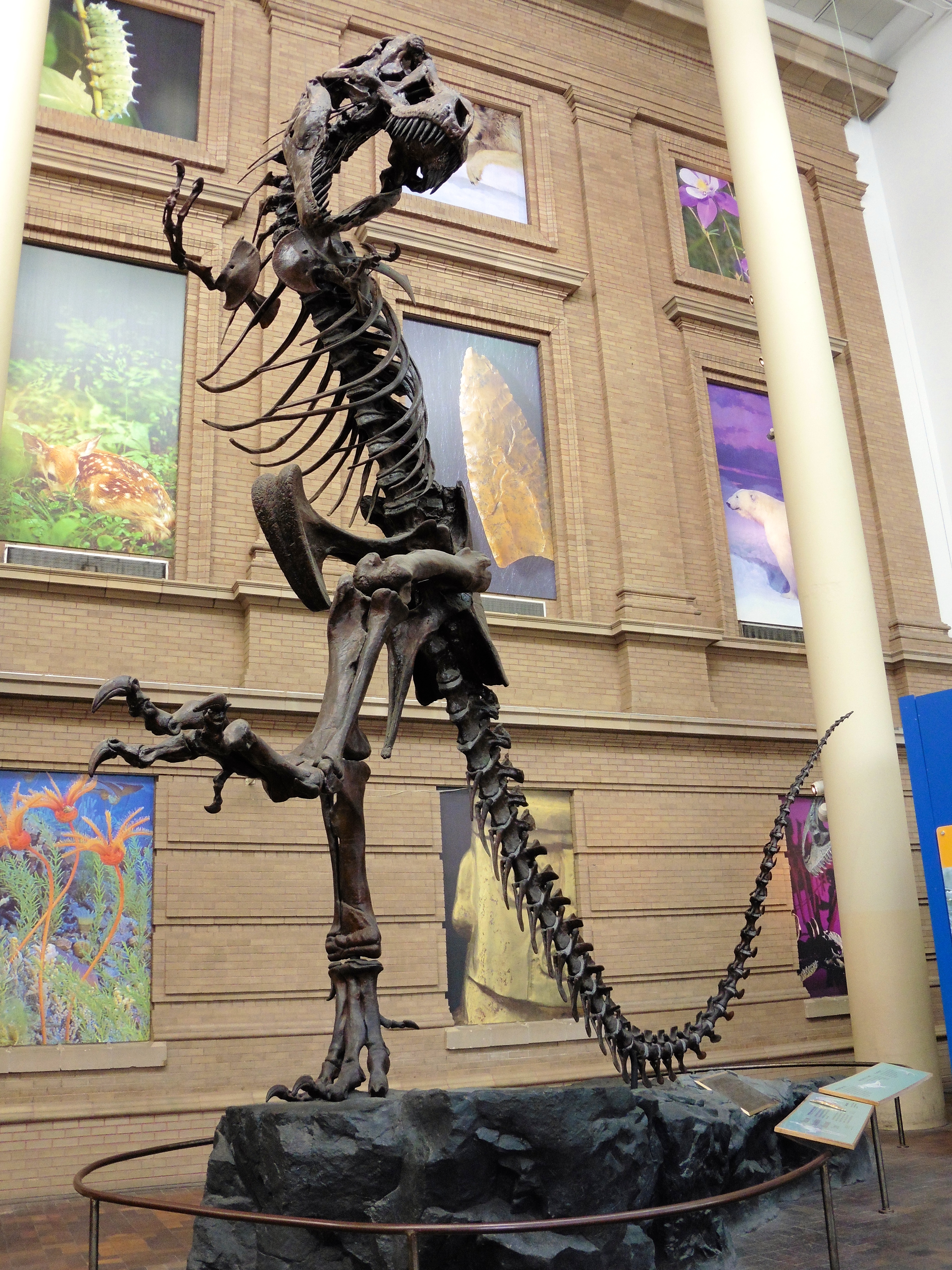
And finally...it wouldn't be a '90s article about dinosaurs without that photo of Bob Bakker posing next to that Tyrannosaurus mount (in Denver). Which looks really cool from this angle, but a little silly from others. Hello ma baby, hello ma honey...